



 English
  中文简体
中文简体 
HOME / NEWS / Industry News / Microfiber Cleanroom Polyester Swab: Types, Specs & Selection
Microfiber cleanroom polyester swabs are the standard precision cleaning and sampling tool for ISO Class 3–8 cleanroom environments, electronics manufacturing, semiconductor fabrication, optics, and medical device assembly. A polyester swab combines a knitted or woven polyester tip — which generates minimal particles, absorbs solvents efficiently, and releases very low levels of extractable ionic contaminants — with a handle made from polypropylene, nylon, or fiberglass that does not shed or outgas in controlled environments. Choosing the correct polyester swab means matching tip style, tip material construction, handle material, and cleanliness certification to the specific process requirement. Using a standard cotton or foam swab in a cleanroom application is not a minor substitution: cotton generates thousands of fiber particles per swab use and foam swabs can leave residue on precision surfaces, both of which cause defects in semiconductor, optical, and medical device processes.
Content
- 1 What Makes a Polyester Swab a Cleanroom Swab
- 2 Polyester Swab Tip Styles and Their Applications
- 3 Handle Materials and Their Impact on Cleanroom Performance
- 4 Key Performance Specifications and Test Methods
- 5 ISO Cleanroom Class Compatibility and Swab Selection
- 6 Primary Applications of Cleanroom Polyester Swabs
- 7 Correct Swab Technique: How Application Method Affects Results
- 8 Polyester Swab Selection Checklist
What Makes a Polyester Swab a Cleanroom Swab
Not every swab with a polyester tip qualifies as a cleanroom swab. The term "cleanroom polyester swab" refers specifically to swabs that have been manufactured, processed, and packaged in a controlled environment, tested against defined particle and ionic contamination limits, and validated for use in cleanrooms of a specified ISO class.
The cleanroom classification of a swab is determined by two main factors: the cleanliness of the manufacturing environment in which the swab was produced and packaged, and the measured contamination levels of the finished product. Leading manufacturers produce polyester swabs in ISO Class 4–6 cleanrooms, individually package them in cleanroom-compatible pouches (double-bagged polyethylene or nylon), and test each production lot for non-volatile residue (NVR), particle counts, and ionic contamination (sodium, chloride, ammonium, etc.) before release.
The Role of Polyester in Contamination Control
Polyester (polyethylene terephthalate, PET) is chosen as the tip material for cleanroom swabs because of its unique combination of properties. As a synthetic thermoplastic, polyester generates dramatically fewer particles than natural fibers: a knitted polyester tip used with IPA typically releases fewer than 100 particles ≥0.5 µm per swab stroke in standardized particle generation testing, compared to thousands of particles from cotton and hundreds from many foam formulations. Polyester also has very low ionic extractables — critical in semiconductor wet processes where ionic contamination on silicon wafers causes gate oxide defects and circuit failures.
Additionally, polyester is chemically compatible with the full range of solvents used in precision cleaning: isopropyl alcohol (IPA), acetone, methyl ethyl ketone (MEK), ethanol, and most fluorinated solvents. It does not dissolve, swell, or leave residue when wetted with these solvents, unlike foam swabs which can degrade with ketones and some chlorinated solvents.
Microfiber Polyester vs. Standard Knit Polyester Tips
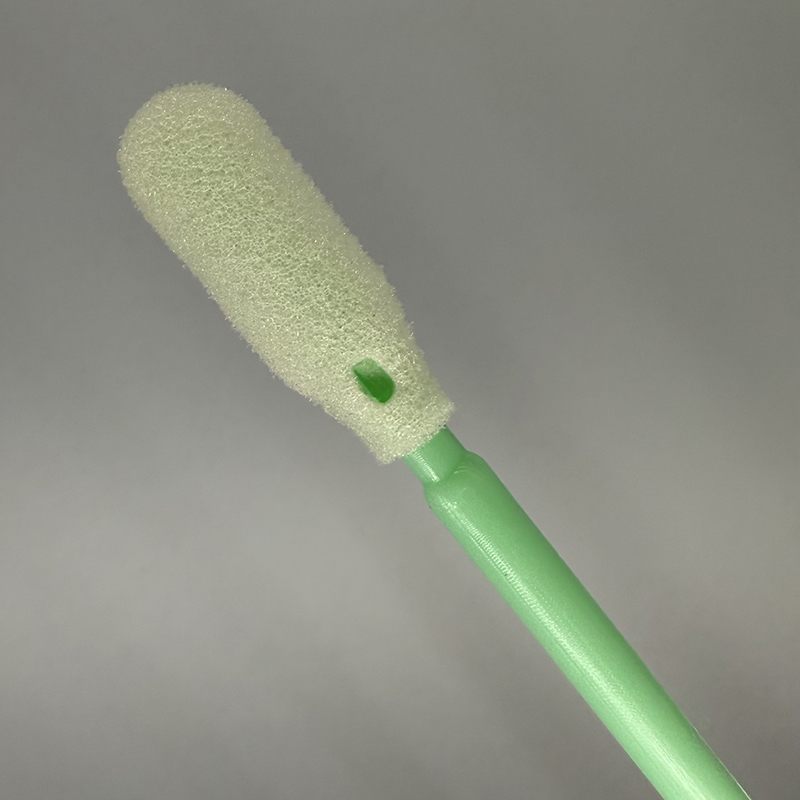
Within the polyester swab category, there is an important distinction between standard knit polyester and microfiber polyester tips. Standard knit polyester uses fibers of 10–25 µm diameter woven or knitted into a tip that provides good solvent absorption and reliable particle performance. Microfiber polyester uses split or ultra-fine fibers of 1–5 µm diameter — similar in concept to microfiber cleaning cloths but engineered to cleanroom standards. The finer fiber structure of microfiber tips increases total surface area, improves wiping efficiency on smooth precision surfaces, enhances capillary absorption, and allows the tip to conform more closely to surface topography when cleaning optical lenses, laser optics, or precision mechanical parts with fine features.
Polyester Swab Tip Styles and Their Applications
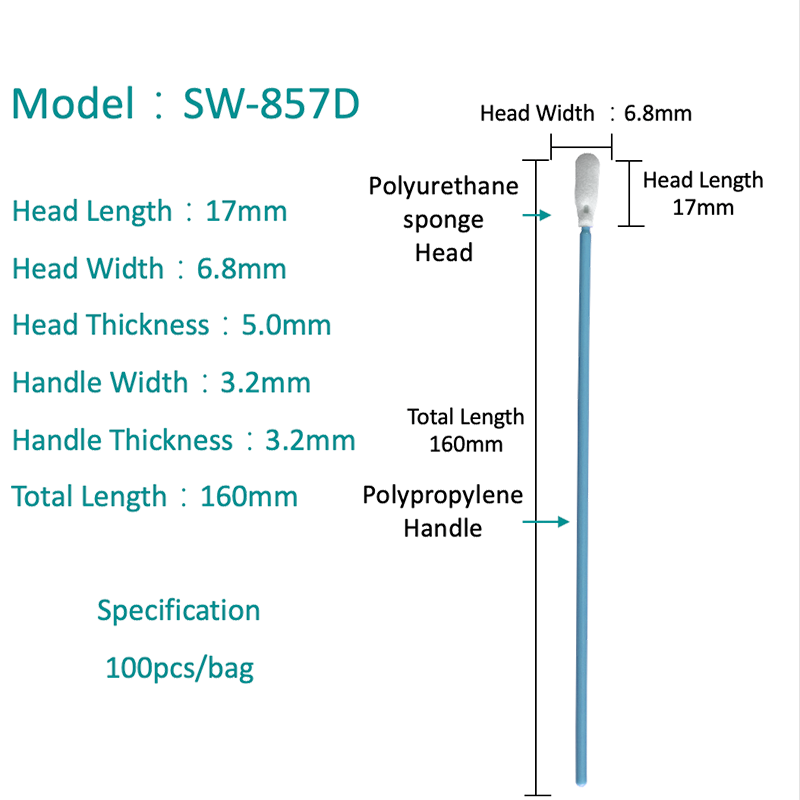
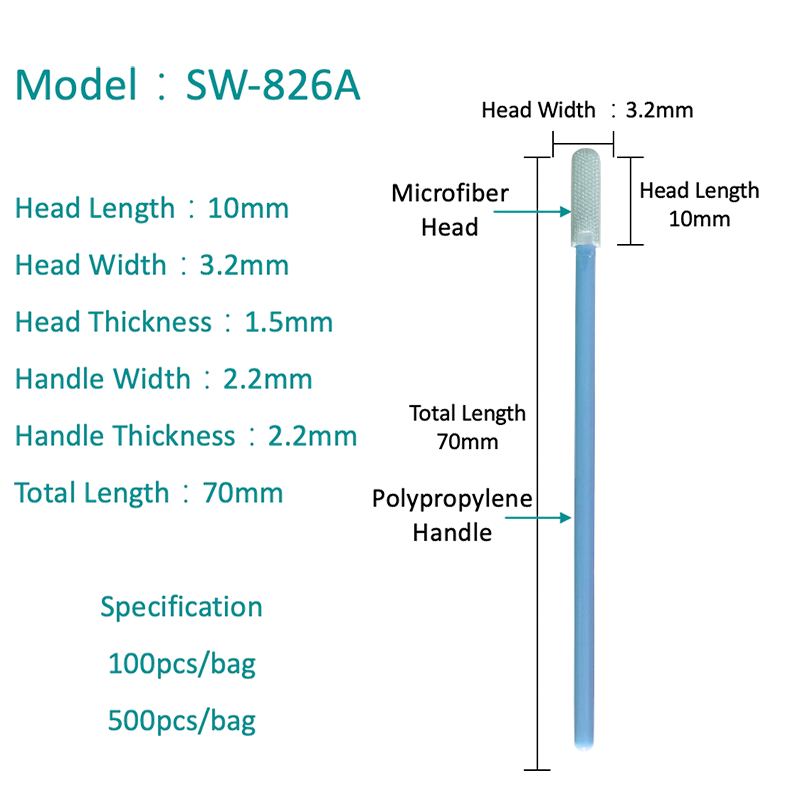
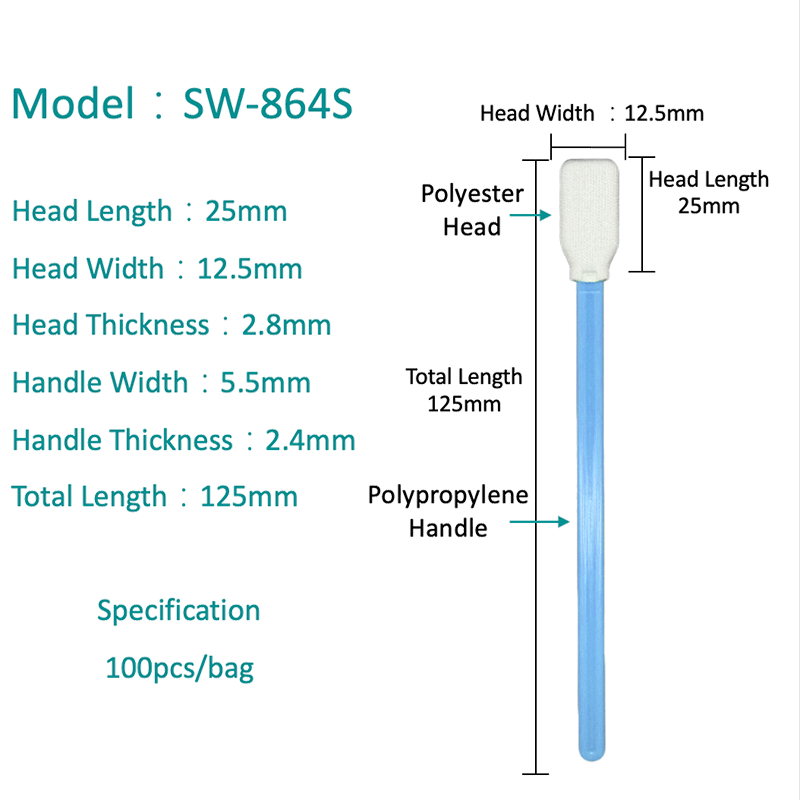
Tip geometry is the primary differentiator between polyester swab models and the most important selection variable after material. Each tip style is optimized for a different surface geometry, access requirement, or cleaning task.
| Tip Style | Shape | Tip Size (approx.) | Primary Applications |
|---|---|---|---|
| Round / Oval | Rounded ball or oval | 3–8 mm diameter | General surface wiping, optical cleaning, flat surface sampling |
| Pointed / Tapered | Conical taper to a fine point | 0.5–2 mm tip diameter | Connector pin cleaning, circuit board via cleaning, fine detail access |
| Paddle / Flat | Flat rectangular paddle | 5–15 mm wide | Flat optical surfaces, disk drive components, large area wiping |
| Chisel | Angled flat edge | 4–8 mm wide | Edges, slots, and corner cleaning; optical fiber end-face cleaning |
| Cylinder / Tube | Cylindrical foam-free tip | 2–6 mm diameter | Barrel connectors, optical fiber ferrules, small bore cleaning |
| Mini / Micro | Miniaturized round or paddle | 1–3 mm | SMD component cleaning, MEMS devices, microelectronics assembly |
Optical Fiber Connector Cleaning: A Specific Tip Requirement
Optical fiber end-face cleaning is one of the most demanding polyester swab applications. The fiber core diameter for single-mode fiber is only 8–9 µm, and contamination on the end-face of an LC, SC, or MTP/MPO connector causes insertion loss and back-reflection that degrade network performance. Specialized polyester swab tips for fiber connector cleaning are precisely sized to the connector ferrule diameter — 1.25 mm ferrule swabs for LC connectors, 2.5 mm ferrule swabs for SC and ST connectors — and are used with IPA in a one-stroke, one-swab protocol (never re-using a swab or making multiple strokes with the same swab) to ensure the end-face is cleaned without recontamination from the swab itself.
Handle Materials and Their Impact on Cleanroom Performance
The handle of a cleanroom polyester swab is not merely a structural carrier — it contributes to the swab's overall particle and outgassing performance and must be compatible with the cleanroom environment and any solvents used during application.
- Polypropylene (PP) handle: The most common handle material for general cleanroom polyester swabs. Injection-molded PP is chemically inert to IPA, ethanol, and most aqueous cleaners; generates very low particles; and is compatible with ISO Class 5–8 environments. PP handles are slightly flexible, which improves comfort during extended cleaning tasks.
- Nylon handle: Higher rigidity than PP, useful when precise tip placement under controlled force is required — for example, when cleaning optical connectors or pressing into recessed areas. Nylon handles are compatible with the same solvents as PP but may absorb small quantities of water from aqueous cleaning solutions over time.
- Fiberglass (GFRP) handle: Used in the most demanding low-outgassing applications — semiconductor process chambers, vacuum environments, and aerospace cleanrooms. Fiberglass handles have extremely low outgassing under vacuum and high-temperature conditions and provide high rigidity for precise force application. They are more expensive than PP or nylon and are specified when total organic carbon (TOC) or outgassing limits are critical.
- Carbon fiber handle: Found in ultra-precision applications requiring both low outgassing and high stiffness-to-weight ratio. Carbon fiber handles are ESD-safe (electrically conductive) by nature, making them suitable for use on ESD-sensitive components where accidental static discharge from the operator through a non-conductive handle is a concern.
- Wood and paper handles: Not acceptable in ISO Class 5 or cleaner environments — wood and paper are significant particle and biological contamination sources. Their presence in any contamination-critical process should be treated as a non-conformance.
Key Performance Specifications and Test Methods
Cleanroom polyester swab datasheets report several standardized test results that allow buyers to compare products objectively. Understanding what these tests measure — and what values are acceptable for a given application — prevents the common error of selecting a product based on marketing language rather than verified performance data.
| Test Parameter | Test Method | Acceptable Value (ISO Class 5) | Why It Matters |
|---|---|---|---|
| Non-Volatile Residue (NVR) | IPA extraction, gravimetric | <100 µg per swab | Residue left on surface after solvent evaporation; critical for optical and semiconductor surfaces |
| Particle Generation (≥0.5 µm) | Liquid particle counter (LPC) | <500 particles per swab | Particles shed from tip during use can deposit on sensitive surfaces and cause defects |
| Ionic Contamination (Na⁺, Cl⁻) | Ion chromatography (IC) | <5 ng/cm² per ion | Ionic contamination causes corrosion on PCBs and dielectric breakdown in semiconductor devices |
| Total Organic Carbon (TOC) | Combustion oxidation / NDIR | <50 µg per swab | Organic residues cause contamination of ultra-pure process chemicals and biological assays |
| Fluid Absorption Capacity | Gravimetric (IPA wet weight) | ≥0.3 mL per swab tip | Determines how much solvent the swab can carry and deliver to the surface during cleaning |
| Bioburden (microbial count) | USP <61> / ISO 11737-1 | <10 CFU per swab (sterile: 0) | Critical for medical device assembly, pharmaceutical cleanrooms, and microbiological sampling |
Sterile vs. Non-Sterile Polyester Swabs
For pharmaceutical manufacturing, medical device assembly, and microbiological environmental monitoring, sterile polyester swabs are required. Sterile swabs are gamma-irradiated after final packaging to achieve a Sterility Assurance Level (SAL) of 10⁻⁶ (one non-sterile unit per million), validated per ISO 11137. Each sterile swab is individually packaged in a peelable pouch with a lot-specific Certificate of Sterility. Non-sterile cleanroom polyester swabs — which are low-bioburden but not SAL-validated — are appropriate for electronics, optics, and semiconductor applications where microbial count is not a process risk.
ISO Cleanroom Class Compatibility and Swab Selection
ISO 14644-1 classifies cleanrooms from ISO Class 1 (fewest particles) to ISO Class 9 (least controlled). The swab selected must be manufactured and packaged in a cleanroom of equal or higher cleanliness than the environment in which it will be used — otherwise the swab itself is a contamination source. The following table maps ISO cleanroom classes to appropriate polyester swab grades.
| ISO Class | Max Particles ≥0.5 µm/m³ | Required Swab Grade | Packaging Standard | Typical Industry |
|---|---|---|---|---|
| ISO 3–4 | 35–352 | Ultra-low NVR, microfiber polyester, fiberglass/carbon handle | Triple-bagged, Class 4 packaged | Advanced semiconductor wafer fab, nanotechnology |
| ISO 5 | 3,520 | Microfiber or standard polyester, PP or nylon handle, certified lot testing | Double-bagged, Class 5 packaged | Semiconductor fab, pharmaceutical aseptic fill, precision optics |
| ISO 6 | 35,200 | Standard polyester, PP handle, lot-tested | Double-bagged | Medical device assembly, disk drive manufacturing |
| ISO 7 | 352,000 | Standard polyester, PP handle | Single or double-bagged | Electronic assembly, aerospace, general precision manufacturing |
| ISO 8 | 3,520,000 | Standard polyester minimum; avoid cotton/foam | Single-bagged or bulk | PCB assembly, general electronics, laboratory |
Primary Applications of Cleanroom Polyester Swabs
Understanding how polyester swabs are used in specific processes clarifies the importance of correct specification and technique, and highlights where substituting a lower-grade product creates measurable risk.
Semiconductor and Wafer Fabrication
In semiconductor fabs, polyester swabs are used to clean process chamber O-ring grooves, quartz components, deposition shields, and equipment surfaces between process runs. The cost of contamination in this context is extreme: a single wafer lot contaminated during a cleanroom cleaning procedure can represent $50,000–$500,000 in product loss depending on the device type. Swabs used in this environment must have ultra-low NVR (typically <50 µg per swab), very low ionic contamination, and must be compatible with the specific cleaning chemistry used — which in semiconductor fabs often includes HF-containing formulations that require evaluation of swab material compatibility.
Optical Component and Lens Cleaning
Optical surfaces — camera lenses, laser optics, telescope mirrors, and precision instrumentation — require the most delicate cleaning technique. Microfiber polyester swab tips, wetted with optical-grade IPA or methanol, are drawn across the optical surface in a single straight stroke (never circular) to lift and carry contamination rather than redistribute it. The extremely fine fiber structure of microfiber tips (1–3 µm fiber diameter) makes contact with the optical coating at a scale that conforms to the surface without scratching, while providing sufficient capillary action to lift particulate and organic contamination. Optical cleaning applications favor paddle or flat-tip swabs for large flat surfaces and pointed or chisel tips for edge cleaning and recessed lens areas.
Printed Circuit Board (PCB) and Electronic Assembly Cleaning
Flux residue removal from solder joints, cleaning of connector contacts, and removal of contamination from under low-clearance components are the primary PCB assembly uses for polyester swabs. IPA-wetted pointed or small-head polyester swabs are used to clean individual solder joints or connector pins without spreading contamination to adjacent areas. Ionic contamination from flux residues on PCBs can cause electrochemical migration and dendrite growth that leads to intermittent shorts and field failures, making thorough cleaning and verification (via ion chromatography testing of board wash solutions) a reliability-critical process step.
Environmental Monitoring and Microbiological Sampling
In pharmaceutical and medical device cleanrooms, sterile polyester swabs are the standard tool for surface bioburden sampling per ISO 14644-9 and EU GMP Annex 1 requirements. The swab is moistened with a neutralizing buffer, wiped across a defined surface area (typically 25 cm²), returned to a transport tube, and cultured to enumerate colony-forming units (CFU). Polyester swab tips are preferred over cotton for microbiological sampling because they release microbial cells more completely into culture medium, improving recovery efficiency by 15–30% compared to cotton swabs in comparative recovery studies — a significant difference when the purpose of testing is to detect low-level contamination at regulatory action limits.
Correct Swab Technique: How Application Method Affects Results
Even the correct swab used incorrectly produces poor cleaning results or causes surface damage. The following best practices reflect industry-standard technique for cleanroom and precision cleaning with polyester swabs.
- One swab, one stroke, one direction: For optical and semiconductor surfaces, each swab should be used for a single pass in one direction only. Re-using a swab or wiping back-and-forth redistributes contamination across the surface. Discard each swab after one use.
- Wet the swab correctly: For IPA cleaning, the swab tip should be wetted — not saturated — so that solvent is delivered evenly without flooding the surface. Excessive solvent can carry contamination under components or into gaps where it cannot evaporate cleanly.
- Follow wet with dry: After cleaning with a solvent-wetted swab, immediately follow with a dry polyester swab to remove solvent and any lifted contamination before they can re-deposit as the solvent evaporates.
- Apply consistent, light pressure: Heavy pressure compresses the tip and reduces its effective surface contact area; for delicate optical coatings, excessive pressure can cause micro-scratches even with soft polyester fiber. Apply only enough pressure for the tip to maintain full contact with the surface.
- Open packaging only in the cleanroom: Polyester swabs packaged in double-bagged cleanroom pouches should have the outer bag removed at the cleanroom entrance and the inner bag opened only at the point of use. Handling the inner bag outside the cleanroom defeats the purpose of clean packaging.
- Never touch the swab tip: Skin contact deposits oils, salts, and skin cells onto the tip, immediately contaminating it. Handle the swab by the handle only; if the tip is accidentally touched, discard the swab.
Polyester Swab Selection Checklist
Applying a structured selection process prevents the most common errors — choosing the wrong tip geometry, underspecifying cleanliness grade, or selecting an incompatible solvent-handle combination — that lead to process failures and contamination events.
- Identify the ISO cleanroom class of the environment where the swab will be used and select a swab manufactured and packaged in a cleanroom of equal or higher class.
- Define the surface geometry and access requirement: flat surface (paddle/flat tip), recessed or narrow (pointed/tapered tip), connector or ferrule (cylinder tip sized to match), or large area (round/oval tip).
- Select tip material: microfiber polyester for optical surfaces, fine features, or maximum wiping efficiency; standard knit polyester for general cleaning, sampling, and lower-sensitivity surfaces.
- Choose handle material based on solvent compatibility and rigidity requirement: PP for general IPA/ethanol use; nylon for higher rigidity; fiberglass or carbon fiber for vacuum, high-temperature, or ultra-low-outgassing requirements.
- Determine sterility requirement: sterile (gamma-irradiated, SAL 10⁻⁶) for pharmaceutical and microbiological sampling; low-bioburden non-sterile for electronics, semiconductor, and optics applications.
- Request lot-specific test reports for NVR, particle generation, and ionic contamination from the supplier; do not rely solely on catalog specification tables, which may reflect best-case results rather than typical production lot performance.

 ADDRESS
 CONTACT
 FAX
FAX EMAIL
EMAIL
