



 English
  中文简体
中文简体 
HOME / NEWS / Industry News / Cleanroom Swab & Dust-Free Foam Head Swab Guide
Cleanroom swabs are precision cleaning and sampling tools engineered to perform in contamination-controlled environments without introducing particles, fibers, ionic residues, or extractable chemicals that could compromise product quality or process integrity — and dust-free foam head cleanroom swabs represent the most widely specified tip type for surface cleaning, solvent wiping, and residue removal in semiconductor, electronics, optical, and medical device manufacturing. The direct answer for most applications: a polyurethane foam head swab on a polypropylene handle, packaged and certified for ISO Class 5 or better cleanroom use, will satisfy the majority of precision cleaning requirements while offering the best balance of particle control, solvent compatibility, absorbency, and cost. Understanding why requires examining how cleanroom swabs are constructed, certified, and selected for specific process conditions.
Content
- 1 What Makes a Swab a Cleanroom Swab
- 2 Dust-Free Foam Head Cleanroom Swab: Construction and Performance
- 3 Cleanroom Swab Tip Types and Their Applications
- 4 ISO Cleanroom Classification and Swab Certification Levels
- 5 Key Testing Parameters for Cleanroom Swab Qualification
- 6 Selecting the Right Cleanroom Swab for Your Application
- 7 Proper Cleanroom Swab Handling and Usage Technique
- 8 Common Cleanroom Swab Tip Geometries and When to Use Each
What Makes a Swab a Cleanroom Swab
A standard cotton swab — even a medical-grade one — is entirely unsuitable for cleanroom use. Cotton fibers shed continuously, release ionic contaminants (chlorides, sulfates), and contain natural organic material that can interfere with adhesion, coating, and bonding processes. A cleanroom swab is fundamentally different in every material and manufacturing aspect:
- Tip material: Foam (polyurethane or polyester), knitted polyester fabric, microfiber, or natural chamois — all selected for extremely low particle generation, minimal ionic extractables, and defined solvent compatibility.
- Handle material: Polypropylene (PP), polystyrene (PS), or nylon — non-shedding, non-static, and free of mold release agents or lubricants used in standard plastic manufacturing.
- Bonding method: The tip-to-handle bond uses ultrasonic welding, heat bonding, or cleanroom-compatible adhesive — never standard contact cement or glue formulations that could outgas solvents or deposit residue.
- Manufacturing environment: Cleanroom swabs are manufactured and packaged in ISO Class 5 to ISO Class 7 cleanrooms to prevent post-production contamination before the package is opened by the end user.
- Packaging: Individual or small-batch sealed packaging — typically heat-sealed polyethylene bags or double-bagged for the most critical applications — with lot number traceability and certification documentation.
Cleanroom swab suppliers provide Certificate of Conformance (CoC) and test data covering particle counts per swab, non-volatile residue (NVR) levels, ionic contamination levels, and in some cases outgassing profiles. These documents are not optional formalities — they are the basis on which process engineers validate swab qualification for specific critical processes.
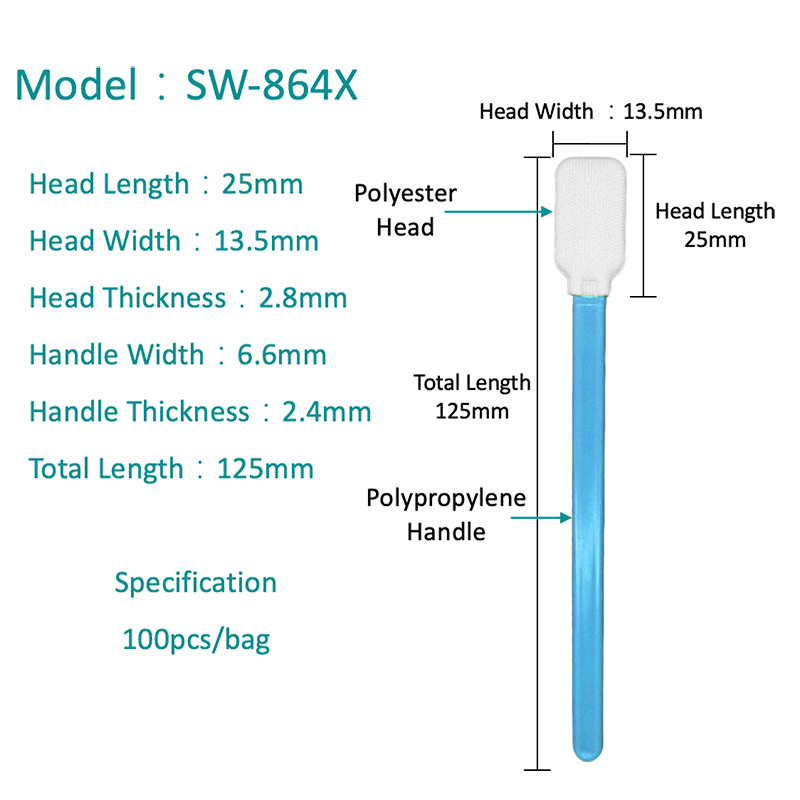
Dust-Free Foam Head Cleanroom Swab: Construction and Performance
The dust-free foam head cleanroom swab is the dominant product in the cleanroom consumables market for good reason: open-cell polyurethane foam combines particle control, solvent absorbency, and surface conformance in a way that no other tip material fully replicates across all three dimensions simultaneously.
Polyurethane Foam Tip Structure
The foam tip of a cleanroom swab is typically made from 100-ppi (pores per inch) to 130-ppi open-cell polyurethane foam — the same grade used in precision lens cleaning and hard disk drive manufacturing. At this pore density, the foam structure has interconnected cells small enough to trap and retain particles down to 0.5µm in diameter while allowing solvents to flow freely through the tip under light compression. The foam is die-cut or molded to the specific tip geometry — rectangular, pointed, paddle, or rounded — and thermally bonded to the handle without adhesive, eliminating a potential source of extractable contamination.
The critical performance metric for a foam cleanroom swab tip is its non-volatile residue (NVR) level — the mass of residue remaining on a surface after the swab has been wet with IPA (isopropyl alcohol) and wiped across a clean substrate, then the IPA is allowed to evaporate. Premium foam cleanroom swabs achieve NVR levels below 0.1 mg per swab, while economy-grade foam swabs may leave 0.5 mg or more — a fivefold difference that is directly relevant in processes such as optical coating, semiconductor wafer cleaning, and precision optics assembly where any residue at the wiping surface is unacceptable.
Polyester Foam vs Polyurethane Foam Tips
Both polyurethane (PU) and polyester (PE) foams are used in cleanroom swab tips, and the distinction matters for solvent-intensive applications:
- Polyurethane foam: Superior absorbency and softness; excellent with IPA, acetone, and aqueous solutions. Not compatible with strong acids, bleach, or MEK (methyl ethyl ketone) which can degrade the foam matrix over extended contact. Best for general electronic cleaning, flux removal, and optical wiping.
- Polyester foam: Greater chemical resistance to aggressive solvents including ketones, esters, and chlorinated solvents. Lower absorbency than PU foam but maintains tip integrity under harsh chemical exposure. Specified for chemical-intensive processes such as aggressive flux removal or surface activation cleaning.
Handle Design and Ergonomics
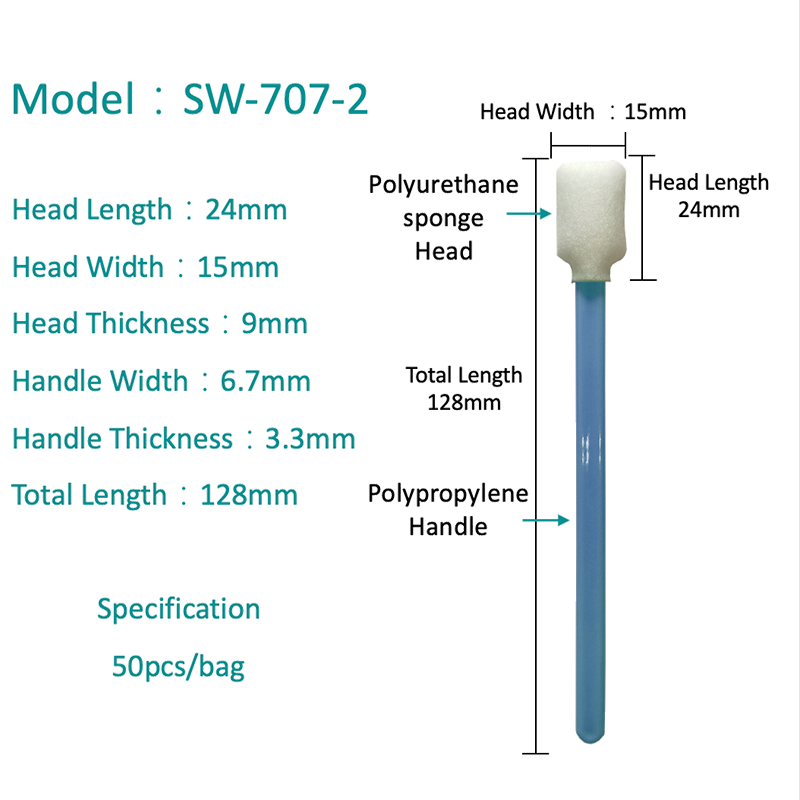
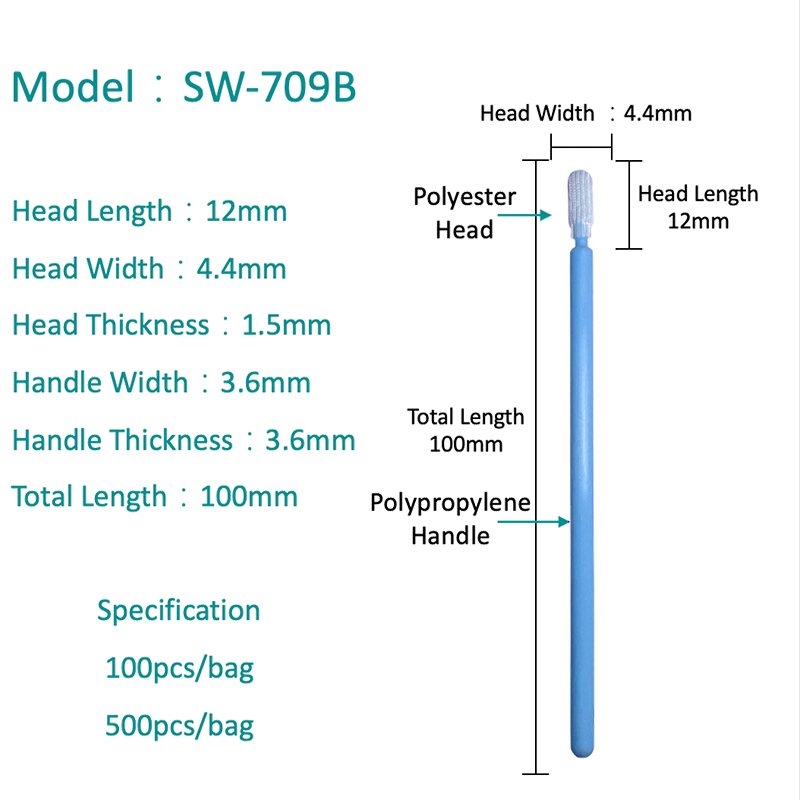
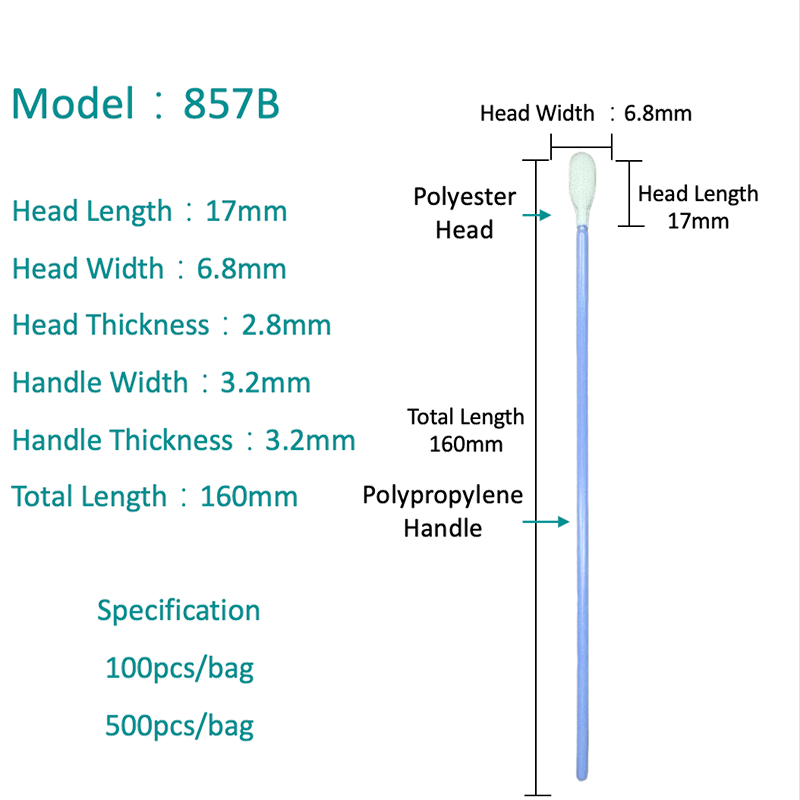
The polypropylene handle is injection-molded to defined dimensional tolerances — typically ±0.1mm in critical dimensions — and surface-treated to prevent static charge buildup in ESD-sensitive environments. Handle length ranges from 70mm for short-reach component cleaning to 190mm or longer for deep cavity or slot access. Some specialized foam head swabs use flexible or bendable handle designs that allow the tip to reach angled or recessed surfaces without the operator repositioning the workpiece.
Cleanroom Swab Tip Types and Their Applications
| Tip Type | Material | Key Strength | Typical Application |
|---|---|---|---|
| Foam (PU) | Open-cell polyurethane | High absorbency, low NVR, particle retention | PCB cleaning, optical wiping, general surface cleaning |
| Foam (Polyester) | Open-cell polyester | Chemical resistance to harsh solvents | Aggressive flux removal, chemical-intensive processes |
| Knitted Polyester | Woven polyester fabric | Abrasion, solvent wipe, broad chemical compatibility | Connector cleaning, mold cavity cleaning |
| Microfiber | Split microfiber fabric | Sub-micron particle pickup, scratch-free | Lens cleaning, display panel wiping, delicate surfaces |
| Natural Chamois | Leather chamois | Ultra-soft, zero scratch risk, high absorbency | Polished metal, optical glass, wafer edge cleaning |
| Cotton (cleanroom grade) | Purified cotton | Soft, economical, absorbent | ISO Class 7–8 general wiping only (not critical surfaces) |
ISO Cleanroom Classification and Swab Certification Levels
Cleanroom swabs are certified and packaged to specific ISO cleanroom classification levels under ISO 14644-1. The ISO class of the swab's packaging and manufacturing environment defines the maximum particle contamination the swab itself will introduce when used correctly. Matching the swab's ISO certification to the classification of the cleanroom where it will be used — or to the cleanliness requirement of the process — is a fundamental procurement decision.
| ISO Class | Max Particles ≥0.5µm per m³ | Swab Certification Required | Typical Industry |
|---|---|---|---|
| ISO Class 3–4 | 35–352 | Class 3–4 certified, double-bagged, sterile optional | Advanced semiconductor wafer processing |
| ISO Class 5 | 3,520 | Class 5 certified, individually sealed | Semiconductor, HDD, precision optics |
| ISO Class 6–7 | 35,200–352,000 | Class 6–7 certified, multi-pack sealed bag | Medical devices, aerospace, electronics assembly |
| ISO Class 8 | 3,520,000 | Class 7–8 certified, sealed packaging | General electronics, pharmaceutical packaging |
It is important to note that a swab certified for ISO Class 5 is manufactured and packaged in an ISO Class 5 environment — but this does not guarantee it will maintain that cleanliness level after the package is opened in a dirtier environment. The swab's certification describes its condition at point of delivery, not its performance in use. Proper handling protocols — opening only in the intended cleanroom class, using within the same session, and not touching the tip with bare hands — are equally important as the swab's initial certification.
Key Testing Parameters for Cleanroom Swab Qualification
When qualifying a cleanroom swab for a specific critical process, the following test parameters are evaluated — either from the supplier's published data sheet or through independent laboratory testing:
Particle Generation (Particle Count per Swab)
Measured by agitating the swab in a defined volume of ultra-pure water and counting particles with a laser particle counter. Premium foam cleanroom swabs generate fewer than 500 particles ≥0.5µm per swab when tested per IEST-RP-CC004 protocol. Economy-grade swabs may generate 5,000 or more particles — a 10× difference that is critical in photolithography and optical coating processes.
Non-Volatile Residue (NVR)
Measured by extracting the swab in a known volume of IPA, evaporating the solvent, and weighing the residue gravimetrically. Expressed in mg per swab or µg/cm². Critical for processes where surface contamination affects adhesion, coating quality, or electrical performance. A typical specification for semiconductor cleaning swabs is NVR < 0.1 mg per swab.
Ionic Contamination
Measured by ion chromatography of the swab extract. Reports levels of specific ions — chloride (Cl⁻), sodium (Na⁺), potassium (K⁺), sulfate (SO₄²⁻), and others — in ng per swab or ppb. Ionic contamination from cleaning tools is a known cause of electrochemical migration (dendritic growth) on PCBs and corrosion of metal contact surfaces. Premium swabs specify total ionic contamination below 10 ng/cm².
Absorbency and Fluid Release
A foam tip's absorbency is measured by immersing a defined tip geometry in IPA and weighing before and after — a standard 6mm × 15mm rectangular foam tip should absorb 0.15 to 0.30 mL of IPA. Equally important is controlled fluid release: the tip should deposit solvent evenly under light wiping pressure without flooding the surface with excess liquid, which could spread contamination rather than remove it.
Selecting the Right Cleanroom Swab for Your Application
With the performance parameters understood, the following decision framework guides swab selection for common cleanroom and precision cleaning scenarios:
For Semiconductor and Wafer Processing
- Specify ISO Class 4 or Class 5 certified polyurethane foam swabs with NVR < 0.05 mg per swab and particle count < 200 per swab.
- Use individually double-bagged packaging; open only inside the cleanroom at the point of use.
- Verify ionic contamination certificates for Cl⁻ and Na⁺ specifically — these are the ions most damaging to semiconductor device reliability.
For PCB and Electronics Assembly Cleaning
- ISO Class 6 or Class 7 foam head swabs are appropriate for most PCB rework, flux residue removal, and connector cleaning applications.
- Choose tip geometry based on the target area: paddle tips for flat surface wiping, pointed or chisel tips for component-to-board junction cleaning, and mini-size foam tips (3mm × 6mm) for fine-pitch component access.
- Confirm IPA and flux solvent compatibility — most standard PU foam swabs are compatible; verify with the supplier if using MEK, NMP, or specialty flux removers.
For Optical and Lens Cleaning
- Microfiber or high-density PU foam tips are preferred — microfiber for sub-micron particle pickup on polished glass, foam for solvent-based smear and coating residue removal.
- Use a single-pass technique — wipe once in one direction and discard. Repeated passes re-deposit particles already picked up in the tip.
- Verify that the tip is lint-free and scratch-free on polished surfaces before committing to a new swab lot — conduct a simple wipe test on a clean reference mirror under oblique light.
For Medical Device Manufacturing
- Sterile-packaged cleanroom swabs (gamma-irradiated or EtO-sterilized) are required for applications involving direct or indirect contact with sterile surfaces or implantable device components.
- Confirm that the swab and its packaging comply with ISO 11135 (sterilization validation) and that bioburden testing data is available from the supplier.
- For cytotoxicity-sensitive applications (implant surface cleaning), request ISO 10993 biocompatibility data for the foam and handle materials.
Proper Cleanroom Swab Handling and Usage Technique
Even the highest-specification swab will underperform if handling and usage technique introduce contamination that the swab is designed to remove. The following practices are standard in ISO Class 5 and cleaner environments:
- Open packaging only at point of use inside the cleanroom — do not pre-open swabs in a lower-class anteroom or staging area.
- Handle by the handle only — never touch the foam tip with fingers, even gloved fingers. Gloves transfer particles and silicone plasticizers to the tip.
- Pre-wet the swab before use by dispensing solvent onto the tip from a controlled-volume squeeze bottle — do not dip the swab into a solvent container, which risks cross-contaminating the bulk solvent supply.
- Use each swab once — a used swab carries the contamination it has already removed. Re-using or reversing the swab to use a "clean side" redistributes contamination rather than removing it.
- Apply consistent, light pressure — excessive force can rupture foam cells, releasing entrapped particles back onto the surface, and can also score delicate substrates such as optical coatings or soft metal contacts.
- Dispose immediately into a designated cleanroom waste container — do not set used swabs on work surfaces where they could contaminate tools, components, or re-enter the cleaning workflow.
Common Cleanroom Swab Tip Geometries and When to Use Each
Foam head cleanroom swabs are manufactured in a range of tip geometries specifically designed for different access and cleaning requirements:
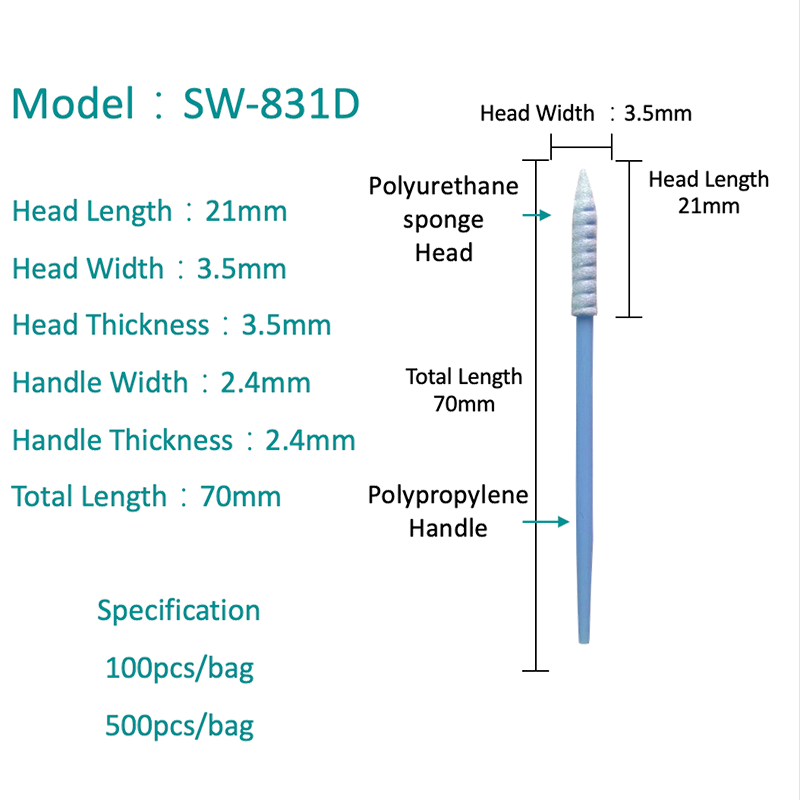
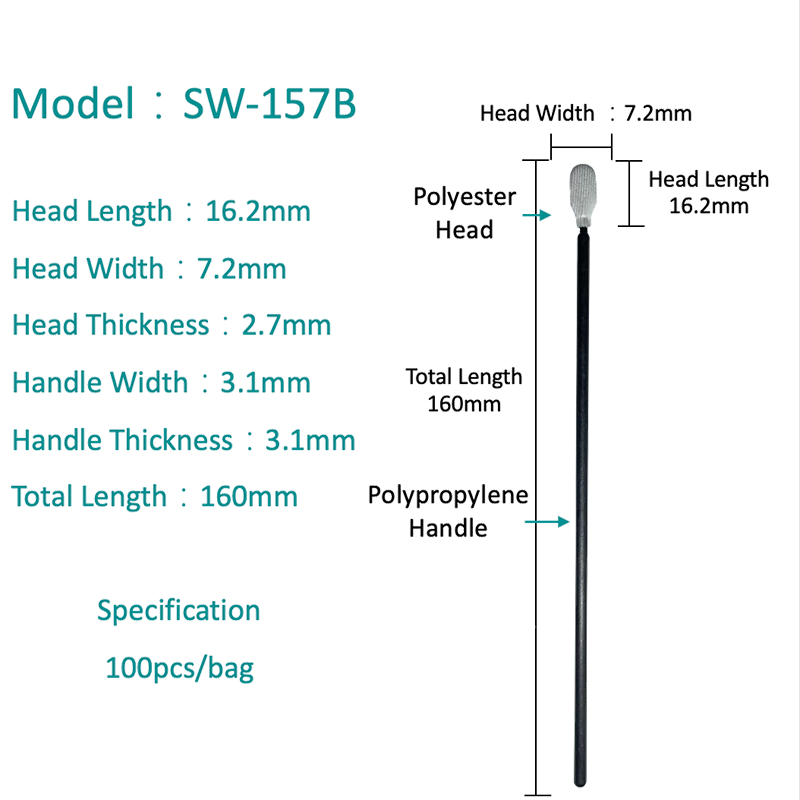
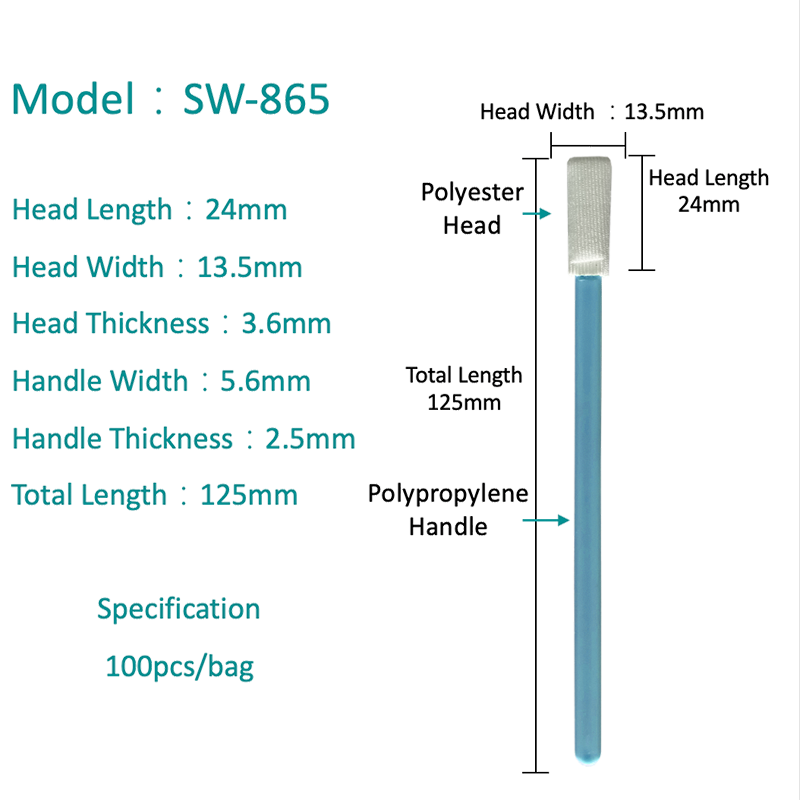
- Rectangular paddle tip: The most common geometry — flat, wide tip for maximum surface coverage on flat substrates, PCB surfaces, and panel wiping. Typical dimensions 6mm × 15mm to 9mm × 20mm.
- Pointed or chisel tip: Narrow, angled foam tip for accessing tight spaces between components, connector pins, and SMT device leads. Essential for rework and precision spot cleaning.
- Round ball tip: Spherical foam tip for socket cleaning, optical fiber end-face cleaning, and circular aperture wiping. The ball geometry ensures consistent contact around the circumference of round features.
- Mini and micro tips: Very small foam tips (2mm × 4mm or smaller) for cleaning fine-pitch BGAs, micro-connectors, and under-component cleaning in advanced electronics. Require steady-hand technique or fixture assistance.
- Wedge tip: Asymmetric tip with a thin leading edge for getting under component bodies and into slot-type features. Used in hard disk drive head gimbal assembly cleaning and precision mechanical cleaning.

 ADDRESS
 CONTACT
 FAX
FAX EMAIL
EMAIL
