



 English
  中文简体
中文简体 
HOME / NEWS / Industry News / Industrial Cotton Swab, Cleanroom Swab and Foam Head Swab: Full Guide
Content
- 1 Why Industrial Swabs Are Not All the Same
- 2 Industrial Cotton Swabs: General Purpose Precision Cleaning
- 3 Cleanroom Cotton Swabs: Controlled Contamination for Critical Environments
- 4 Foam Head Swabs: Low Particle Generation and Superior Solvent Loading
- 5 Side-by-Side Comparison of All Three Swab Types
- 6 Solvent Compatibility and Chemical Resistance Considerations
- 7 How to Choose the Right Swab for Your Application
Why Industrial Swabs Are Not All the Same
Industrial swabs -- including industrial cotton swabs, cleanroom cotton swabs, and foam head swabs -- are precision cleaning and application tools used across electronics manufacturing, semiconductor fabrication, medical device assembly, optical systems, and general industrial maintenance. Despite their deceptively simple appearance, the differences between swab types are significant in terms of particle generation, chemical compatibility, absorption capacity, and tip geometry.
Selecting the wrong swab for a critical cleaning task can introduce contamination rather than remove it, damage sensitive surfaces, or leave behind residues that cause downstream process failures. This guide covers how each swab type is constructed, what it is designed to do, and the specifications that determine suitability for a given application.
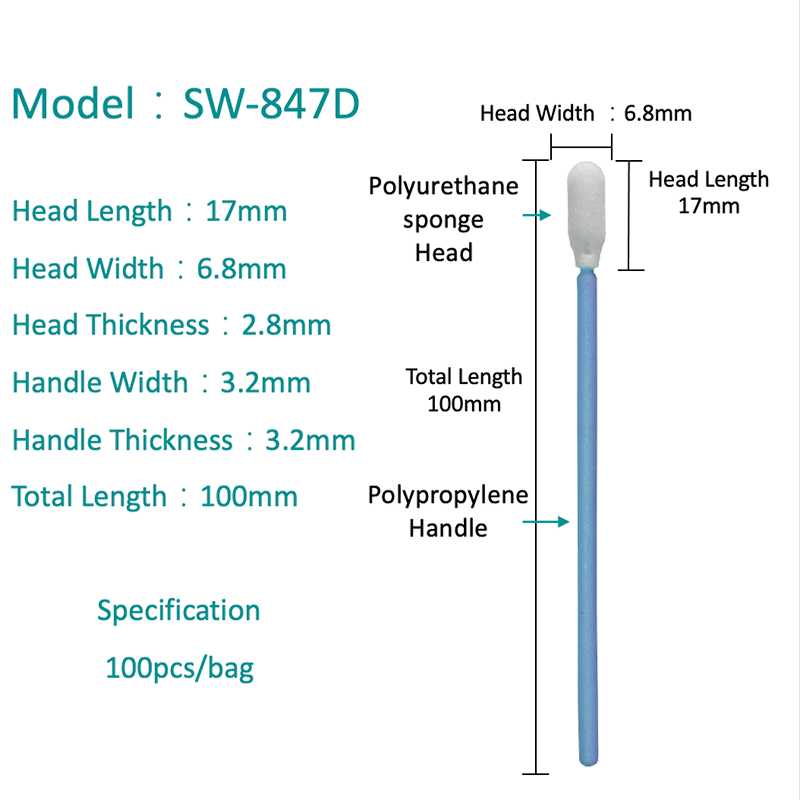
Industrial Cotton Swabs: General Purpose Precision Cleaning
An industrial cotton swab is a step above the consumer-grade cotton bud in every measurable dimension. While household swabs use loosely wound raw cotton on a paper or plastic stick, industrial cotton swabs are manufactured to tighter tolerances with higher-purity cotton, more consistent tip geometry, and handles made from wood, polypropylene, or paper that do not introduce contamination under normal handling conditions.
The cotton tip in an industrial swab is typically knitted or wrapped rather than twisted, which reduces loose fiber shedding during use. The absorbent capacity of cotton makes these swabs well suited for applying and removing solvents, lubricants, adhesives, and cleaning agents in confined or recessed areas that larger tools cannot access. Tip shapes vary widely -- round, pointed, paddle, and tapered profiles serve different access and surface contact requirements.
Typical applications for industrial cotton swabs
- Cleaning PCB contact points, connector pins, and switch contacts during electronics repair and maintenance
- Applying flux, thermal paste, or conformal coating to localized areas during electronics assembly
- Removing excess adhesive, sealant, or lubricant from machined surfaces and assembly joints
- Cleaning ink residues, mold release agents, and surface contaminants in printing and packaging equipment
- Swabbing small bore components, nozzles, and orifices in pneumatic and hydraulic systems
Limitations of standard industrial cotton swabs
Despite their versatility, standard industrial cotton swabs have measurable limitations in high-precision applications. Cotton is a natural fiber that inherently sheds particles -- even knitted tips release some fibers under mechanical stress. Cotton also has variable chemical resistance: it degrades in contact with strong oxidizing agents and some aggressive solvents. In applications where particle counts, ionic contamination, or chemical compatibility are tightly controlled, a more specialized swab type is required.
Cleanroom Cotton Swabs: Controlled Contamination for Critical Environments
A cleanroom cotton swab is manufactured, packaged, and validated specifically for use in ISO-classified cleanroom environments. The defining characteristic is not just the swab material itself, but the entire production and packaging chain designed to minimize particulate and ionic contamination at every stage before the swab reaches the point of use.
Cleanroom swabs are typically manufactured in ISO Class 5 or better controlled environments, double-bagged in cleanroom-compatible packaging, and validated to meet defined particle count and non-volatile residue (NVR) specifications. The cotton used is highly purified -- processed to remove natural waxes, oils, and non-cellulosic materials -- and the tip construction minimizes fiber release under the mechanical loads encountered during swabbing.
Handle materials in cleanroom swabs
Handle material selection is as important as tip material in cleanroom applications. The most common options and their characteristics are:
- Polypropylene (PP) handles: The most widely used cleanroom swab handle material. Low particle generation, good chemical resistance to common IPA and acetone-based cleaning solvents, and consistent dimensional tolerances. Autoclavable grades are available for sterile processing environments.
- Purified wood handles: Used where a degree of flexibility or a natural feel is preferred. Lower chemical resistance than PP but acceptable for many electronics cleaning applications. Must be sourced from certified cleanroom-grade suppliers to avoid resin and extractable contamination.
- Polystyrene (PS) handles: Rigid and dimensionally stable, used in applications requiring consistent tip pressure and positioning. Lower solvent resistance than PP -- incompatible with ketones and some chlorinated solvents.
Cleanroom swab validation and specification parameters
When sourcing cleanroom cotton swabs for critical applications, the following validated parameters should be requested from the supplier:
- Non-volatile residue (NVR): The mass of residue remaining after evaporation of a solvent extract, expressed in micrograms per swab. Lower NVR indicates fewer extractable contaminants that could transfer to the work surface.
- Particle counts: The number of particles above a defined size (typically 0.5 micron and 5 micron) released per swab under standardized agitation conditions.
- Ionic contamination: Total extractable ions (sodium, chloride, ammonium, and others) per swab, relevant in electronics and semiconductor applications where ionic residues cause corrosion or electrical leakage.
- Sterility: For pharmaceutical, medical device, and microelectronics applications requiring biological contamination control, sterile cleanroom swabs validated to ISO 11135 or equivalent are available.
Foam Head Swabs: Low Particle Generation and Superior Solvent Loading
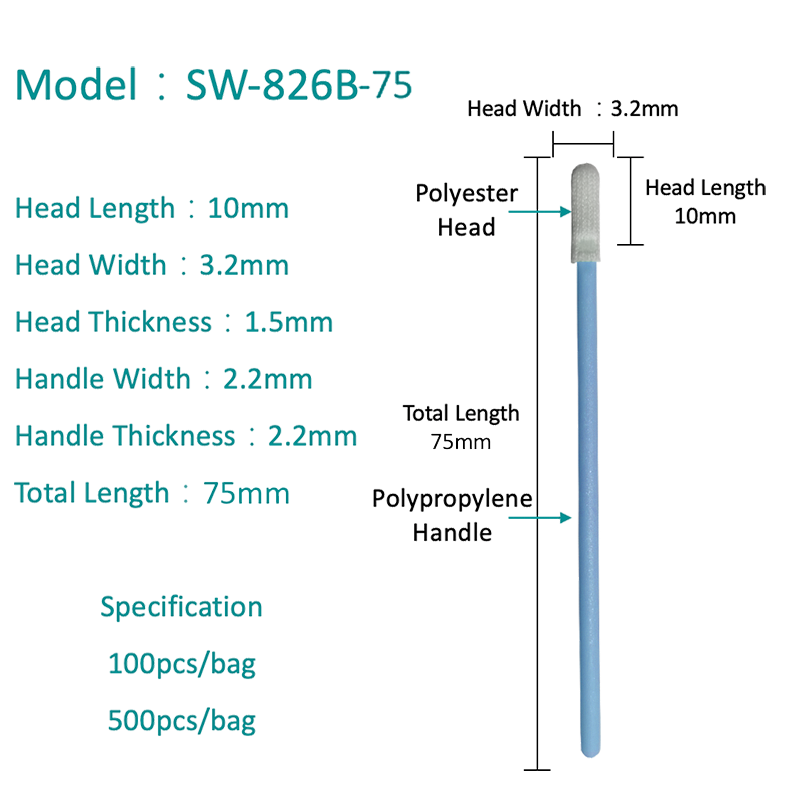
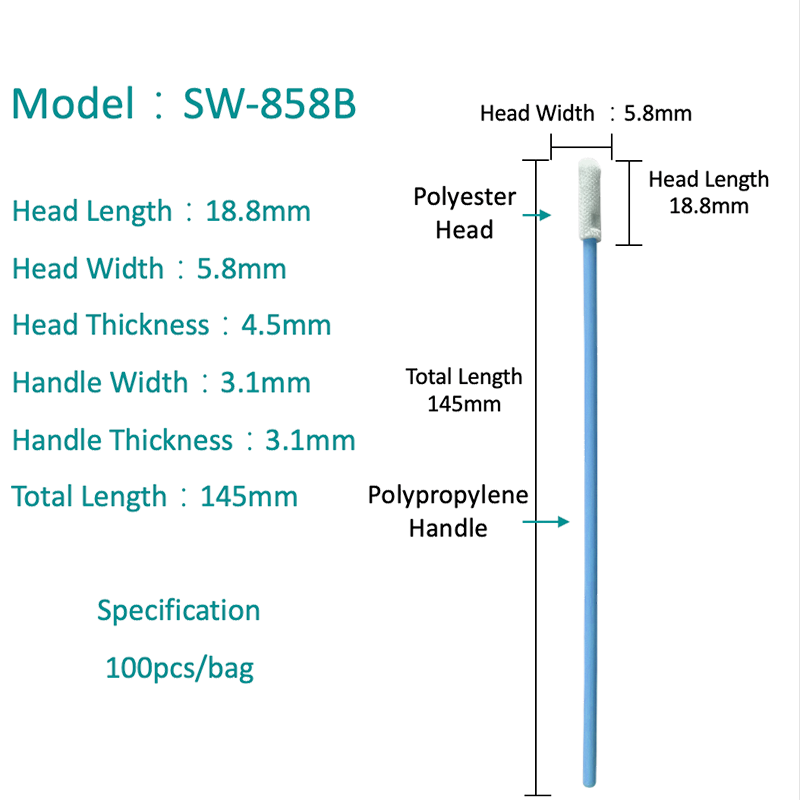
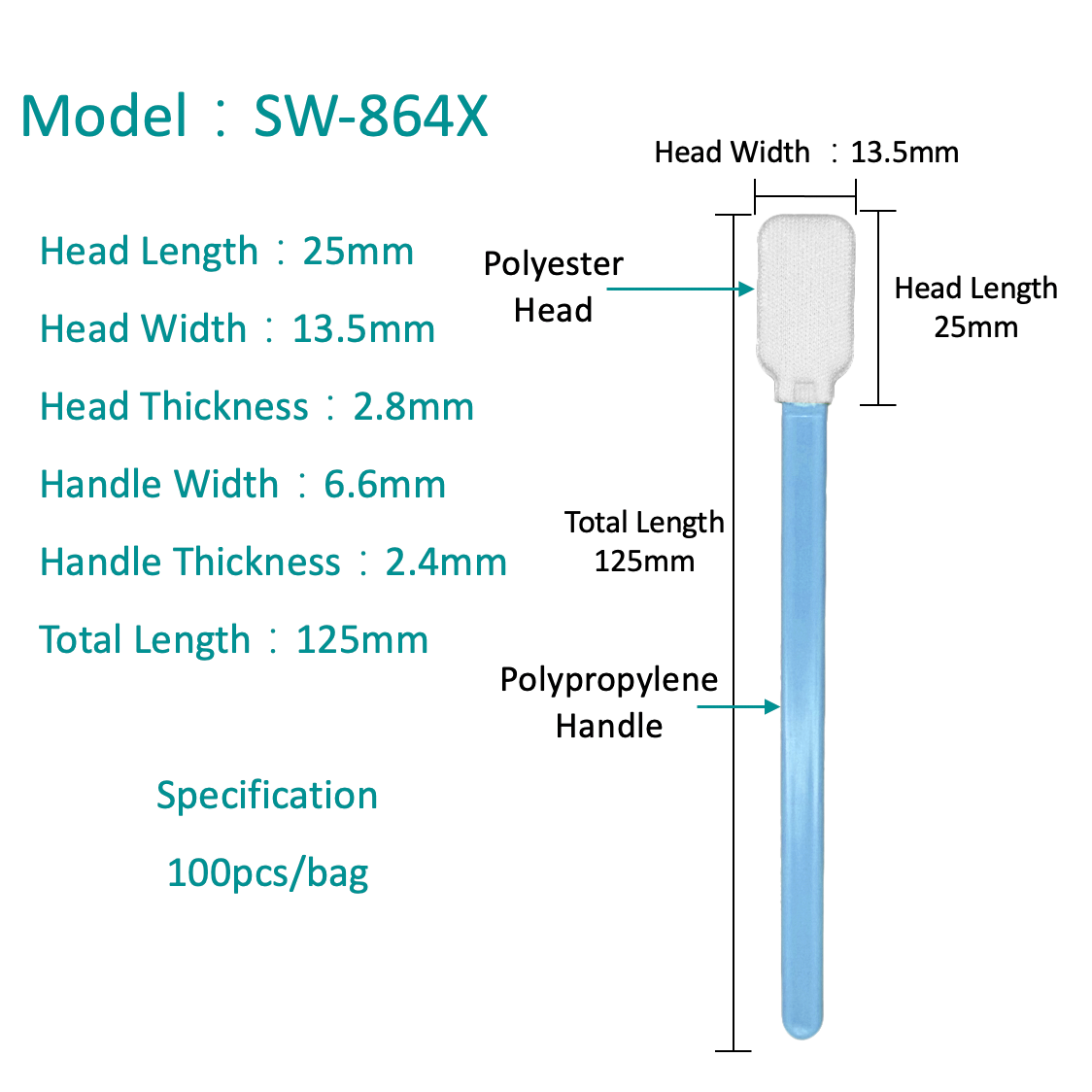
A foam head swab replaces the cotton tip with a molded or die-cut open-cell polyurethane or polyester foam tip. This single material substitution fundamentally changes the performance profile of the swab: foam generates significantly fewer particles than cotton under mechanical stress, making foam head swabs the preferred choice in the most contamination-sensitive applications in semiconductor, hard disk drive, optical, and flat panel display manufacturing.
Open-cell foam tips absorb and retain liquid through capillary action within the cell structure. This gives foam swabs a high and consistent liquid loading capacity -- they pick up and release solvent in a more controlled manner than cotton, which can drip or unevenly distribute liquid under compression. Foam also produces a more uniform wiping action on flat surfaces, as the compliant tip conforms to the surface geometry without abrading it.
Foam types and their performance characteristics
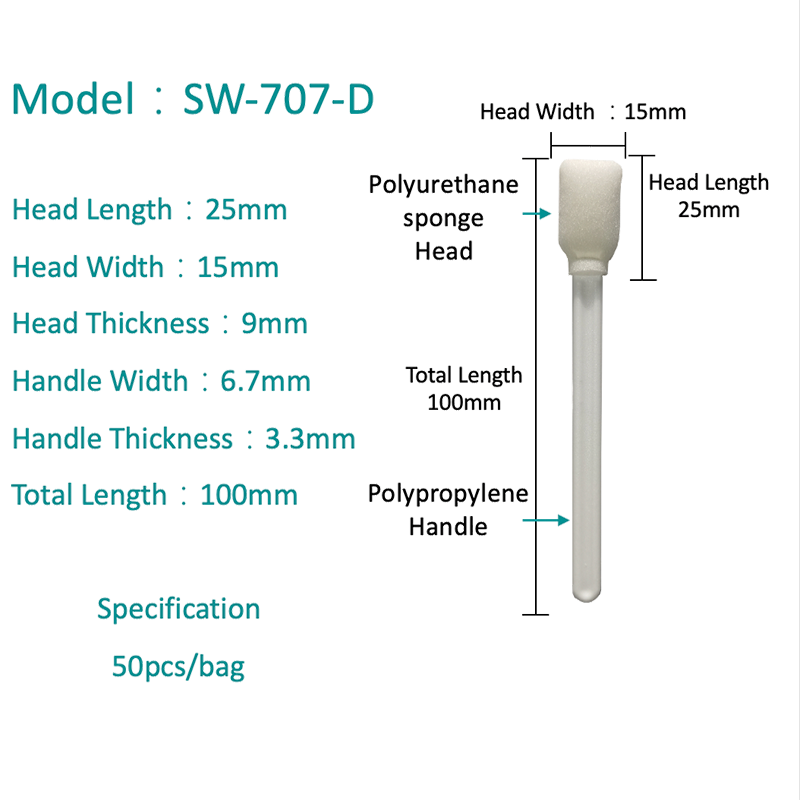
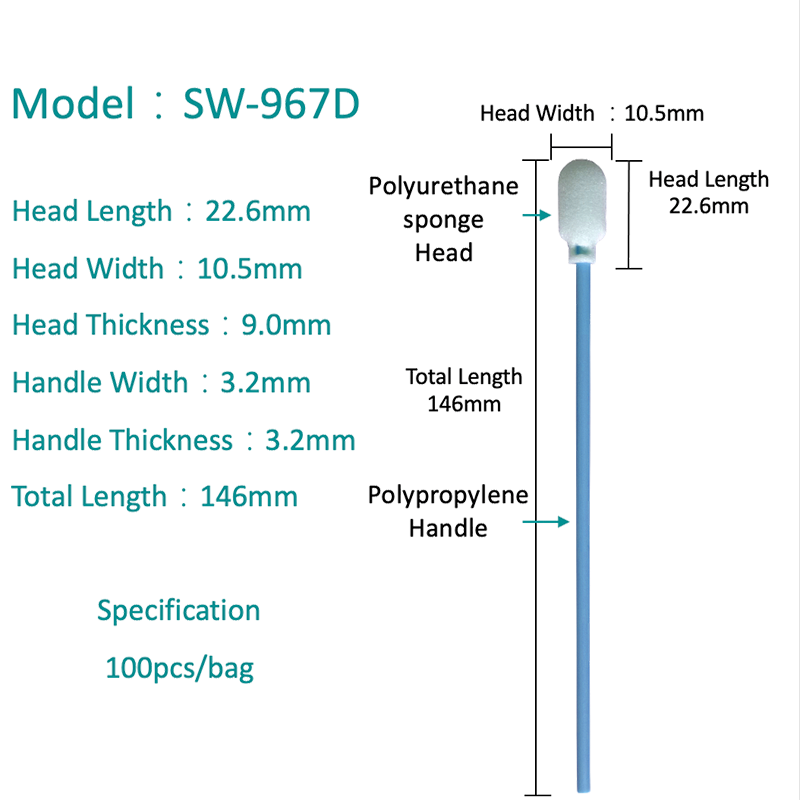
- Polyurethane (PU) foam tips: The most common foam swab material. Available in a range of pore sizes (fine, medium, coarse) which determine absorbency and surface contact characteristics. Compatible with IPA, acetone, methanol, and most common cleaning solvents. Not recommended for prolonged contact with strong acids or oxidizers.
- Polyester foam tips: Higher chemical resistance than polyurethane, particularly to ketones, esters, and chlorinated solvents. Lower NVR and extractables than PU foam, making polyester foam the preferred tip material for the most critical semiconductor and optical applications. Typically higher cost than PU.
- Reticulated foam tips: A modified open-cell structure with the cell membranes removed, producing a fully interconnected pore network. Reticulated foam has lower flow resistance and higher absorbency than standard open-cell foam -- used in applications requiring maximum solvent uptake and controlled release.
Foam head swab tip geometries
Foam tips are available in a broader range of precision geometries than cotton tips, because foam can be die-cut or molded to tighter dimensional tolerances. Common profiles include:
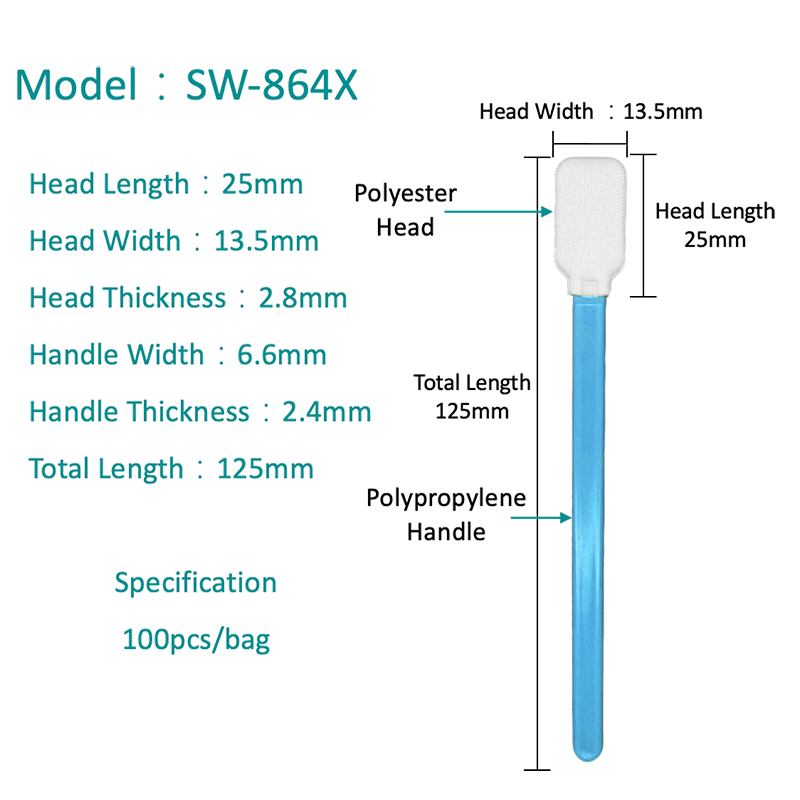
- Rectangular paddle tips for wiping flat surfaces and slot openings in hard disk drive and flat panel display manufacturing
- Pointed or chisel tips for accessing corners, grooves, and recesses in optical assemblies and connector bodies
- Round and elliptical tips for general surface cleaning and solvent application
- Miniature micro tips with tip widths of 1 to 3 mm for cleaning under fine-pitch components and SMD pads on densely populated PCBs
Side-by-Side Comparison of All Three Swab Types
| Parameter | Industrial Cotton Swab | Cleanroom Cotton Swab | Foam Head Swab |
|---|---|---|---|
| Tip material | Purified cotton | High-purity cotton | Polyurethane or polyester foam |
| Particle generation | Moderate | Low (validated) | Very low |
| Absorbency | High | High | High and controlled |
| Surface abrasion risk | Low to moderate | Low | Very low |
| Chemical resistance | Moderate | Moderate | High (polyester foam) |
| NVR and ionic validation | Not typically validated | Validated per lot | Validated per lot |
| Packaging | Standard poly bag | Double-bagged cleanroom pack | Double-bagged cleanroom pack |
| Typical ISO class suitability | ISO Class 7 and below | ISO Class 5 to 7 | ISO Class 3 to 6 |
| Unit cost | Low | Medium | Medium to high |
Solvent Compatibility and Chemical Resistance Considerations
Swab tip material and handle material must both be chemically compatible with the solvent or cleaning agent being used. Incompatibility causes tip degradation, handle softening, or extractable contamination that transfers onto the surface being cleaned -- the opposite of the intended outcome.
The most commonly used cleaning solvents in industrial and cleanroom swab applications, and their compatibility with swab materials, follow a consistent pattern. Isopropyl alcohol (IPA) at 70 to 99 percent concentration is compatible with cotton, polyurethane foam, polyester foam, polypropylene handles, and purified wood handles -- making it the universal default solvent for electronics and general cleanroom cleaning. Acetone is compatible with cotton and polyester foam but degrades polyurethane foam tips and polystyrene handles. Methyl ethyl ketone (MEK) and other aggressive ketones require polyester foam tips and polypropylene handles as the minimum specification.
When cleaning with flux removers, optical cleaning solutions, or specialty chemicals, the swab supplier should be consulted for compatibility data before use in production. Pre-saturated swabs -- supplied wetted with a specific solvent and sealed in foil pouches -- eliminate solvent metering variability and are increasingly used in standardized cleaning processes where consistency is critical.
How to Choose the Right Swab for Your Application
Selecting the correct swab type requires answering five practical questions before specifying a product:
- What is the cleanliness requirement of the environment? General industrial maintenance can use standard industrial cotton swabs. ISO Class 6 to 7 environments require cleanroom cotton or foam swabs with validated particle counts and NVR. ISO Class 3 to 5 semiconductor and optical applications typically require polyester foam swabs with the lowest available NVR and ionic contamination specifications.
- What surface is being cleaned? Delicate optical coatings, polished metal surfaces, and soft polymer components require low-abrasion foam tips. Robust metal components and connector bodies tolerate cotton tips without risk of surface damage.
- What geometry is needed for access? Deep recesses, narrow slots, and fine-pitch components require pointed, chisel, or micro tip profiles. Flat surface wiping is best served by paddle or rectangular foam tips.
- What solvent or cleaning agent will be used? Confirm compatibility between the solvent, tip material, and handle material before introducing a swab into a cleaning process.
- Is lot traceability and certification required? Regulated industries including medical device manufacturing and aerospace typically require certificate of conformance, lot-specific test data for NVR and particles, and documented manufacturing environment classification for each swab order.
In practice, many facilities maintain more than one swab type: industrial cotton swabs for general maintenance tasks, cleanroom cotton or foam swabs for subassembly cleaning in controlled areas, and validated polyester foam swabs for final cleaning of critical surfaces and optical components. Matching the swab specification to the actual contamination sensitivity of each task avoids both over-specification cost and under-specification risk.

 ADDRESS
 CONTACT
 FAX
FAX EMAIL
EMAIL
