



 English
  中文简体
中文简体 
HOME / NEWS / Industry News / Cleanroom Polyester Swab vs Other Swabs: Types, Uses & Selection Guide
What Makes a Cleanroom Polyester Swab Different From a Standard Swab
A cleanroom polyester swab is a precision cleaning and sampling tool engineered specifically for controlled environments — semiconductor fabrication, pharmaceutical manufacturing, medical device assembly, aerospace component processing, and data storage production — where contamination by particles, fibers, ionic residues, or nonvolatile residue (NVR) can cause product failure, yield loss, or regulatory non-compliance. The distinctions between a cleanroom polyester swab and a general-purpose or consumer swab are not superficial — they reflect fundamental differences in construction, material purity, manufacturing environment, and validated performance.
Standard swabs — including cotton-tipped laboratory swabs, foam swabs sold for electronics cleaning, and consumer cotton buds — are manufactured without contamination controls on fiber shedding, ionic content, or NVR levels. Cotton swabs shed loose fibers with each wiping stroke; the adhesive used to bond tip to handle may outgas or dissolve in solvents; and the handle itself may be made from wood or uncontrolled-grade plastic that introduces particulate or chemical contamination into the cleaning process.
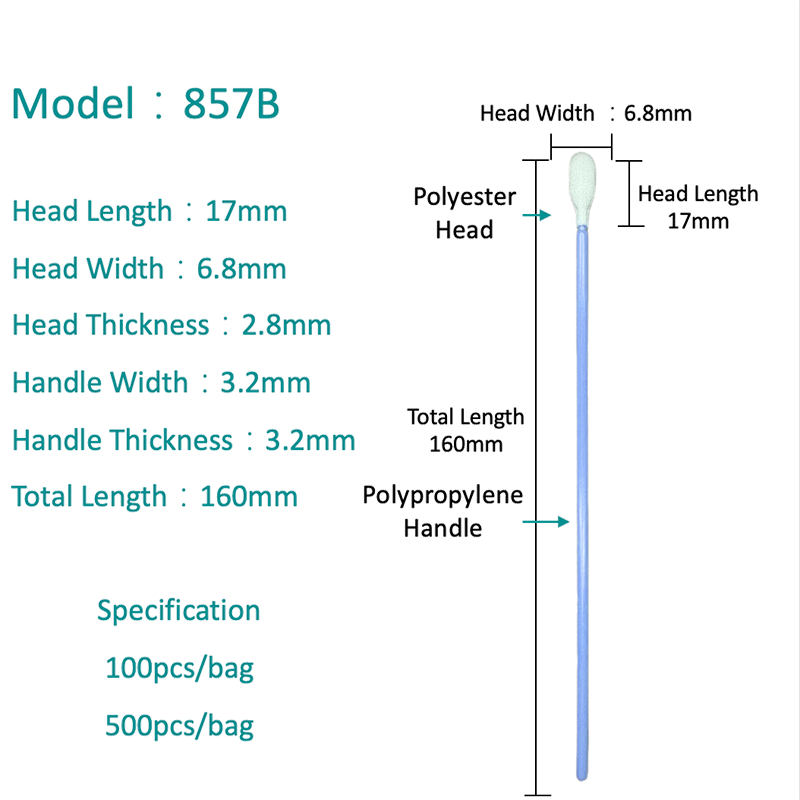
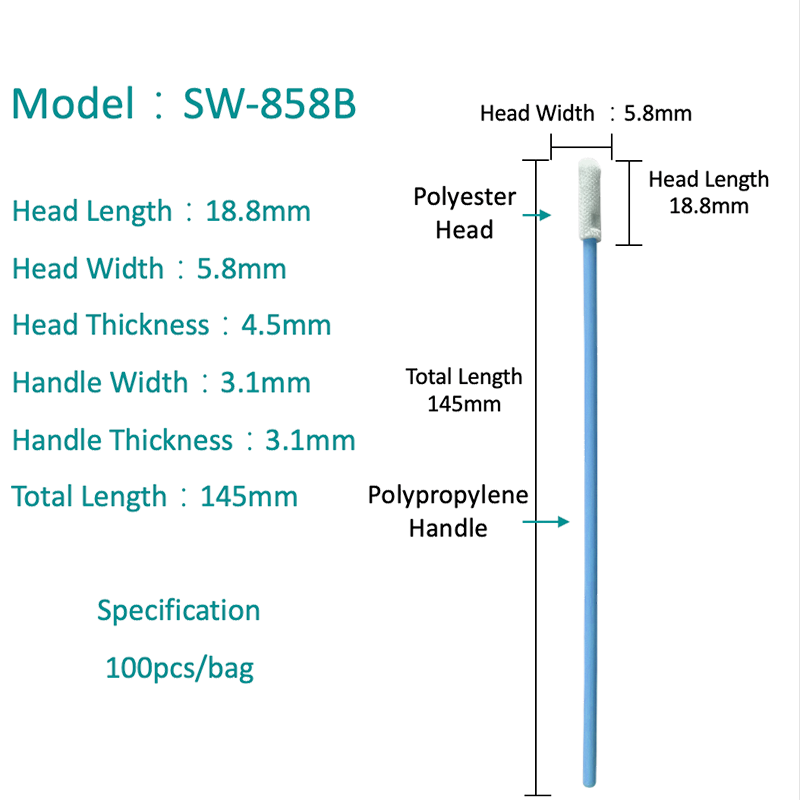
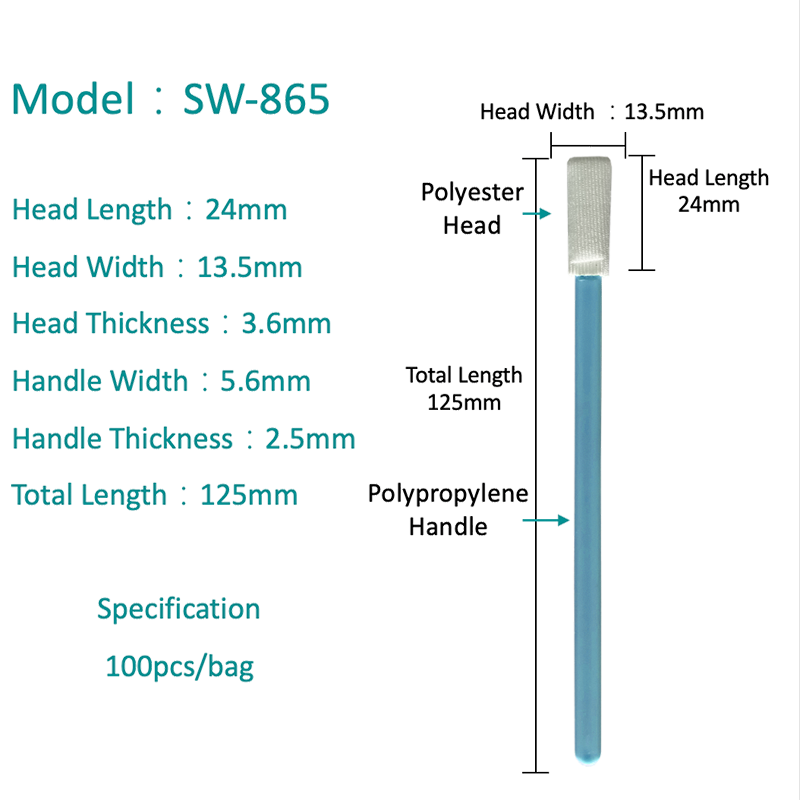
Cleanroom polyester swabs address each of these failure modes systematically. The tip is constructed from knitted or woven polyester fabric — typically 100% continuous-filament polyester — that is thermally bonded or sewn to eliminate adhesive, processed in an ISO-classified cleanroom, and double-bagged in cleanroom-compatible packaging. The handle is injection-molded from polypropylene or nylon in a controlled environment. The finished product is tested and certified for particle count, NVR, ionic content, and often for specific chemical compatibility — providing the traceability and documentation that cleanroom quality systems require.
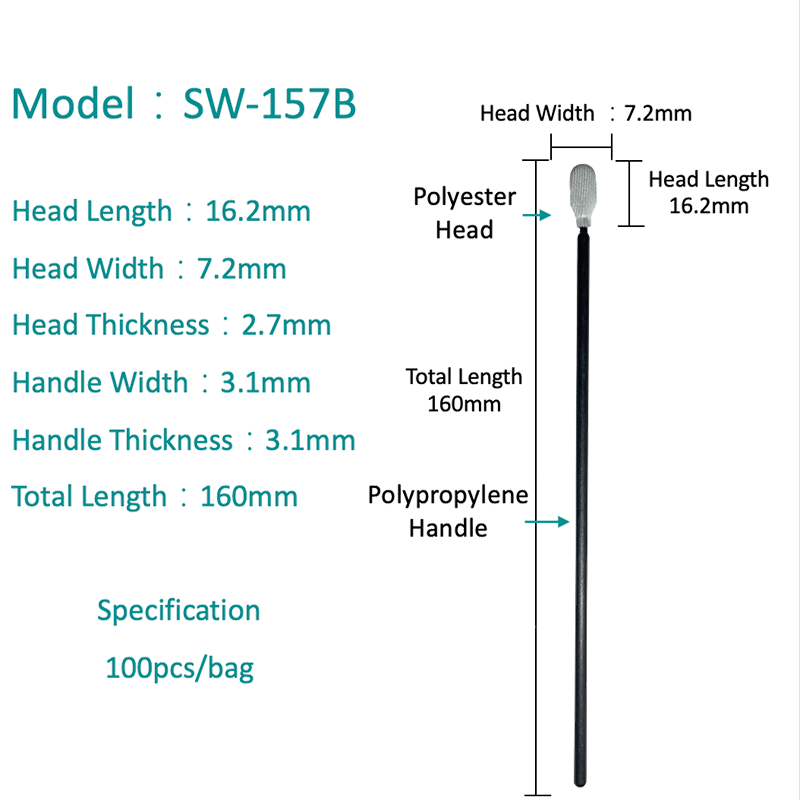
Cleanroom Polyester Swab vs Foam Swab: Where Each Excels
Foam swabs are the most direct competitor to polyester swabs in cleanroom applications, and the choice between them is genuinely application-dependent rather than a clear hierarchy of quality. Both are used widely in ISO Class 3–8 cleanrooms; the decision comes down to the specific cleaning task, solvent system, and surface geometry involved.
Cleanroom polyester swabs outperform foam in several contexts. Polyester fabric tips have a defined, consistent surface texture that provides mechanical scrubbing action against particulate contamination — the woven or knitted structure physically dislodges particles from surfaces rather than only absorbing them. Polyester is chemically compatible with a broader range of aggressive solvents including ketones, esters, and aromatic hydrocarbons that degrade polyurethane foam tips, causing them to break down and deposit foam fragments on the surface being cleaned — the opposite of the intended outcome. For applications involving IPA (isopropyl alcohol), acetone, MEK, or aggressive flux removers, polyester swabs maintain tip integrity where foam would fail.
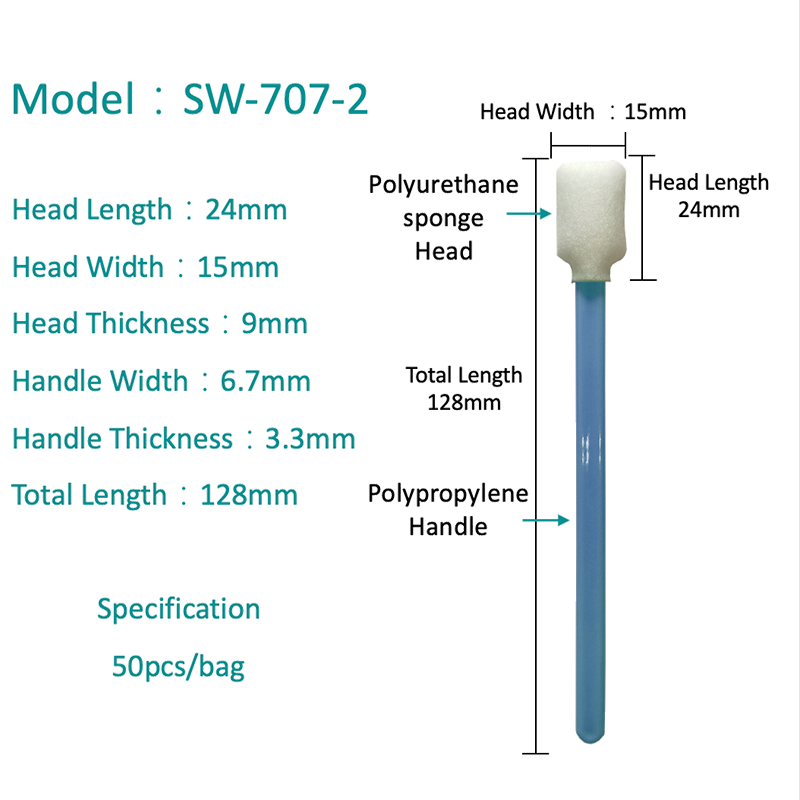
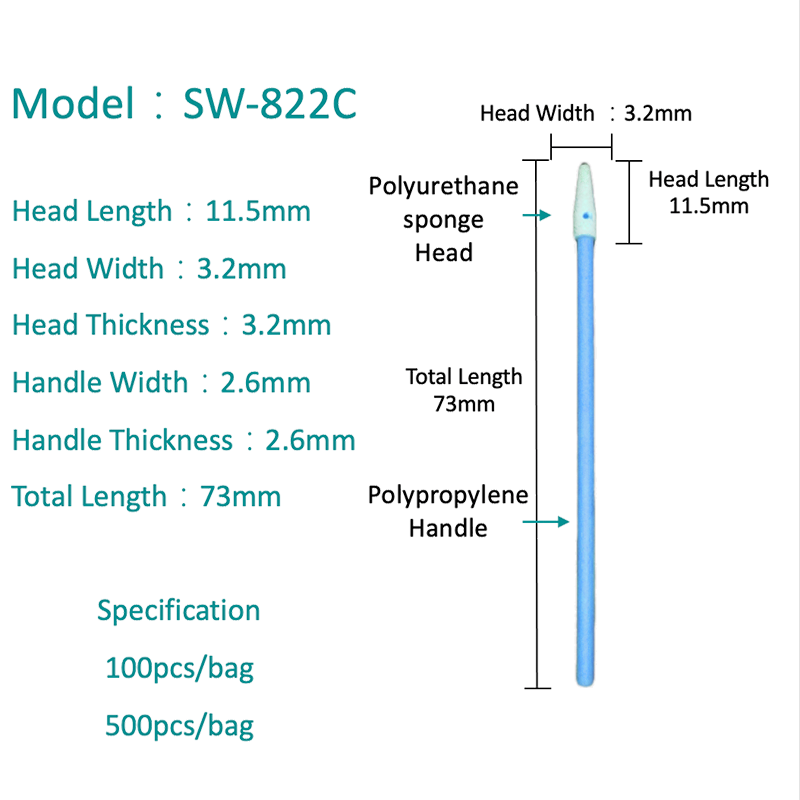
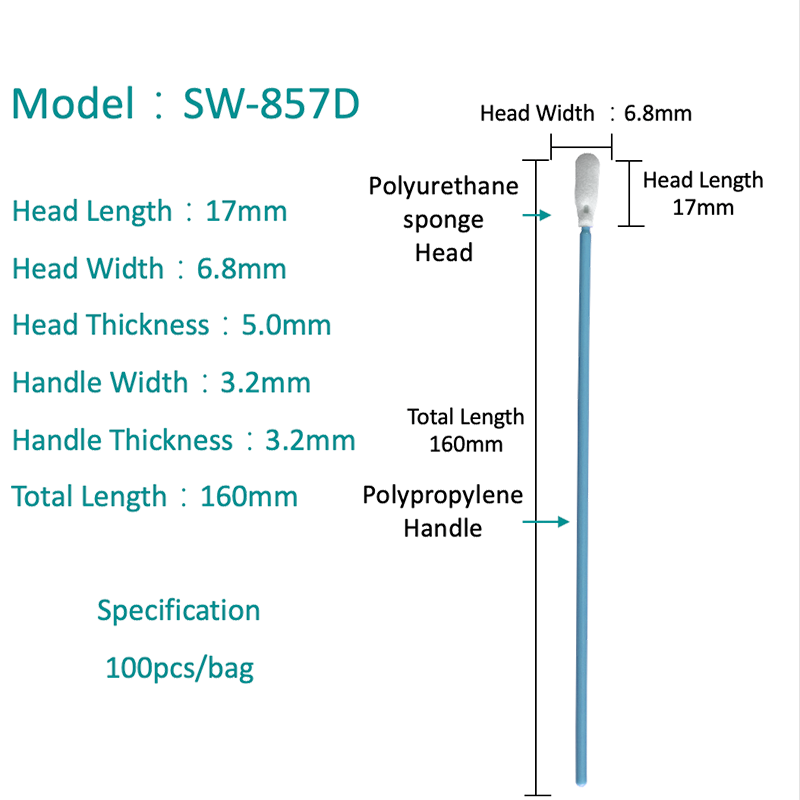
Foam swabs hold advantages in applications requiring high fluid uptake and controlled release. Open-cell polyurethane foam absorbs and retains significantly more solvent per unit volume than polyester knit fabric, making foam swabs preferable for applying cleaning agents to large areas, saturating crevices, or carrying reagents to sampling sites. Foam also conforms more readily to irregular surface contours under gentle pressure, making it effective for cleaning recessed features, connectors, and irregular geometries where polyester fabric's lower compliance produces uneven contact. For flux residue removal from populated PCB assemblies where solvent volume delivery matters, foam swabs are often more effective than polyester.
The critical trade-off is solvent compatibility versus fluid capacity — a decision matrix that should be established explicitly during process validation rather than defaulting to one tip material for all cleaning steps.
Cleanroom Polyester Swab vs Cotton, Microfiber, and Specialty Tip Materials
Beyond foam, several other tip materials appear in cleanroom and precision cleaning contexts, each with distinct performance profiles relative to polyester:
- Cotton swabs in cleanroom contexts: Laundered and processed cotton swabs exist in the market as a lower-cost alternative to polyester for less demanding cleanroom applications. However, cotton is a natural fiber with inherent variability in fiber length, diameter, and surface chemistry. Even processed cleanroom cotton swabs shed more particulate than continuous-filament polyester, retain higher baseline ionic contamination from agricultural processing residues, and absorb moisture from the environment — changing tip weight and potentially introducing humidity-related contamination. For ISO Class 5 and cleaner environments, cotton swabs are generally inadequate; for Class 7–8 applications with moderate cleanliness requirements, they may be acceptable at reduced cost.
- Microfiber swabs: Constructed from split-fiber polyester or polyester-polyamide microfiber, these tips achieve very low particle counts and high mechanical cleaning efficiency due to the electrostatic attraction between the split fibers and sub-micron particles. Microfiber swabs are particularly effective for optical surface cleaning — lens elements, laser optics, and sensor windows — where both particle removal efficiency and avoidance of surface scratching are critical. The trade-off is higher cost and more limited solvent compatibility compared to standard polyester knit, as some microfiber constructions use polyamide components that swell or degrade in certain solvents.
- Knitted polyester vs woven polyester tip construction: Within the polyester swab category itself, knitted tips offer more stretch and surface conformance than woven constructions, making them more effective on curved or irregular surfaces. Woven polyester provides a more consistent, dimensionally stable tip that maintains its shape under lateral scrubbing pressure — preferred for flat surface cleaning where tip deformation would reduce contact uniformity.
- Polyester-wrapped foam (composite tips): Some premium cleanroom swabs combine a foam core with a polyester fabric outer layer — gaining the solvent resistance and low-particle-shedding properties of polyester on the contact surface while retaining the fluid capacity advantage of foam internally. These composite constructions cost more than either single-material option but can outperform both in applications that require both aggressive solvent use and high fluid delivery simultaneously.
| Swab Tip Type | Particle Shedding | Solvent Compatibility | Fluid Capacity | Best Application |
|---|---|---|---|---|
| Cleanroom Polyester | Very Low | Broad (incl. ketones) | Moderate | General precision cleaning, aggressive solvents |
| Foam (PU) | Low | Limited (no ketones) | High | Fluid delivery, PCB flux removal |
| Microfiber | Extremely Low | Moderate | Low–Moderate | Optics, sensors, sub-micron particle removal |
| Cotton (Cleanroom) | Moderate | Good (IPA, water) | Moderate–High | Class 7–8, lower-criticality cleaning |
| Polyester-Wrapped Foam | Very Low | Broad | High | Demanding applications requiring both properties |
Specifying and Validating Cleanroom Swabs for Process-Critical Applications
For process-critical applications in semiconductor, pharmaceutical, and medical device manufacturing, selecting a cleanroom polyester swab is not the end of the specification process — it is the beginning of a validation cycle that confirms the swab performs as required in the specific process context. Reputable cleanroom swab manufacturers provide standardized test data including NVR per swab (typically expressed in micrograms, measured after solvent extraction), particle counts per swab at defined size thresholds (often ≥0.5 µm and ≥5 µm), ionic contamination levels (chloride, sodium, ammonium per swab), and extractable metals profiles for semiconductor applications with tight metallic contamination limits.
Process validation should also verify swab compatibility with the specific solvents used in the process, not just generic chemical families. IPA from different suppliers can contain varying levels of water, ketones, and aldehyde impurities that interact differently with swab materials. Validation at the process level — using production solvents, at process temperatures, with the specific swabbing motion and pressure used by operators — is the only reliable confirmation that published swab specification data translates to acceptable contamination levels in the actual application.
Handle material and geometry deserve attention in the specification process. Polypropylene handles are standard and compatible with most solvents; however, in applications involving aggressive aromatics or chlorinated solvents, handle material compatibility should be confirmed since handle dissolution or extraction can contribute more NVR than the tip itself. Handle stiffness and tip-to-handle geometry affect operator access to confined spaces — a flexible handle allows access to recessed connectors and deep cavities that a rigid handle cannot reach, while a rigid handle provides more force transmission for mechanical scrubbing of contamination from flat surfaces.
Finally, packaging and storage conditions affect swab cleanliness at point of use. Double-bagged swabs in heat-sealed polyethylene cleanroom bags maintain ISO classification from manufacture through use; single-bagged swabs are adequate for less critical applications. Storage in stable temperature and humidity conditions — away from chemical storage areas where outgassing could contaminate swab surfaces through packaging — preserves the NVR and ionic cleanliness specifications certified at manufacture. Swabs stored improperly for extended periods should be re-tested before use in critical processes rather than assumed to meet original certification data.

 ADDRESS
 CONTACT
 FAX
FAX EMAIL
EMAIL
