



 English
  中文简体
中文简体 
HOME / NEWS / Industry News / What Is a Swab? Lint Free Swabs Explained — Types, Materials & Uses
Content
What Is a Swab? Definition and Core Function
A swab is a small, handled tool consisting of an absorbent or wiping tip mounted on a stick, handle, or shaft. Its primary function is to apply, absorb, collect, or transfer a substance — liquid, solid, biological material, or contaminant — in a controlled, precise manner within a confined or delicate area where larger tools cannot reach or where contamination risk must be minimized.
The term covers an exceptionally broad product category. A cotton bud used in personal care, a foam-tipped swab used to clean a camera sensor, a polyester swab used to collect a DNA sample at a crime scene, and a sterile rayon swab used in a clinical throat culture are all swabs — but each is engineered to a fundamentally different performance specification. Swab selection is application-driven: the tip material, handle material, geometry, cleanliness level, and sterility status must all be matched to the task.
The Two Main Functional Roles of a Swab
Despite the diversity of the category, swabs perform one of two primary functions in industrial, scientific, and medical practice:
- Application and cleaning — delivering a solvent, lubricant, adhesive, or cleaning agent to a targeted surface; removing contamination, flux residue, dust, or debris from a component or surface without introducing new contaminants in return
- Collection and sampling — capturing biological specimens (cells, bacteria, viruses), environmental contamination (particles, residues), or forensic evidence from a surface for subsequent analysis or culture
In critical environments — electronics manufacturing, pharmaceutical cleanrooms, medical device assembly, optical fabrication — a swab must not only perform its primary function but must do so without contributing particles, fibers, ionic contamination, or extractable chemicals to the surface or component being treated. This is where lint free swabs become the mandatory specification.
What Is a Lint Free Swab?
A lint free swab is a swab whose tip material releases minimal or no loose fibers, particles, or debris during use. The term "lint" refers to the short fibers that shed from cut or woven textile surfaces — particularly from natural fibers like cotton — which, once deposited on a sensitive surface, can cause electrical failures on PCBs, optical defects on lenses and sensors, contamination of sterile pharmaceutical fills, or erroneous results in molecular diagnostic assays.
True lint free performance is not a binary property but a measurable characteristic. Swabs used in ISO Class 4 or Class 5 cleanrooms must meet particle count specifications verified by liquid particle counting or optical microscopy per standards such as IEST-RP-CC004. For less critical applications, "low-lint" is a practical descriptor indicating significantly reduced fiber shedding compared to standard cotton swabs, without necessarily meeting a quantified particle count specification.
Why Cotton Swabs Are Not Lint Free
Standard cotton-tipped swabs — the consumer product familiar in personal care — are constructed from natural cotton fibers that are inherently variable in length, not chemically bonded to each other, and prone to releasing fibers when the tip is compressed, dragged, or wetted with solvent. A single cotton swab can shed thousands to tens of thousands of particles per wipe under typical use conditions. For cleaning a circuit board connector, a fiber bridging two solder pads can cause a short circuit. For wiping a camera sensor, a single cotton fiber leaves a visible artifact across multiple frames. For pharmaceutical vial sampling, fiber contamination is a direct quality non-conformance.
This is not a flaw in cotton swabs — it is simply a property that makes them suitable for their intended applications (personal hygiene, cosmetics application, craft work) and unsuitable for precision cleaning and critical sampling.
Lint Free Swab Tip Materials: Properties and Selection
The tip material is the defining performance variable of a lint free swab. Each material offers a distinct combination of cleanliness, absorbency, chemical compatibility, and mechanical properties:
Polyester Knit
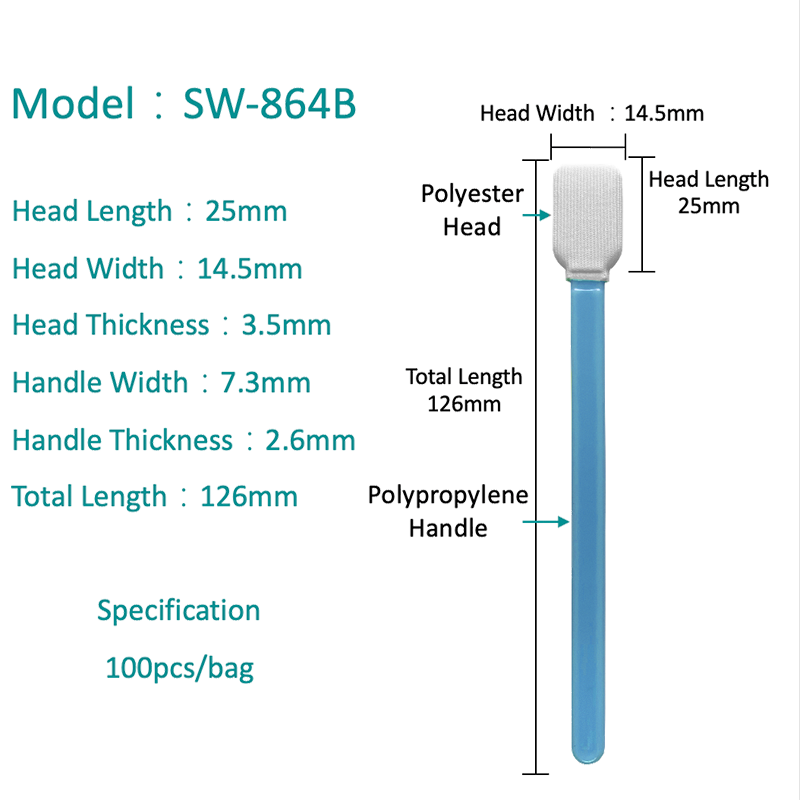
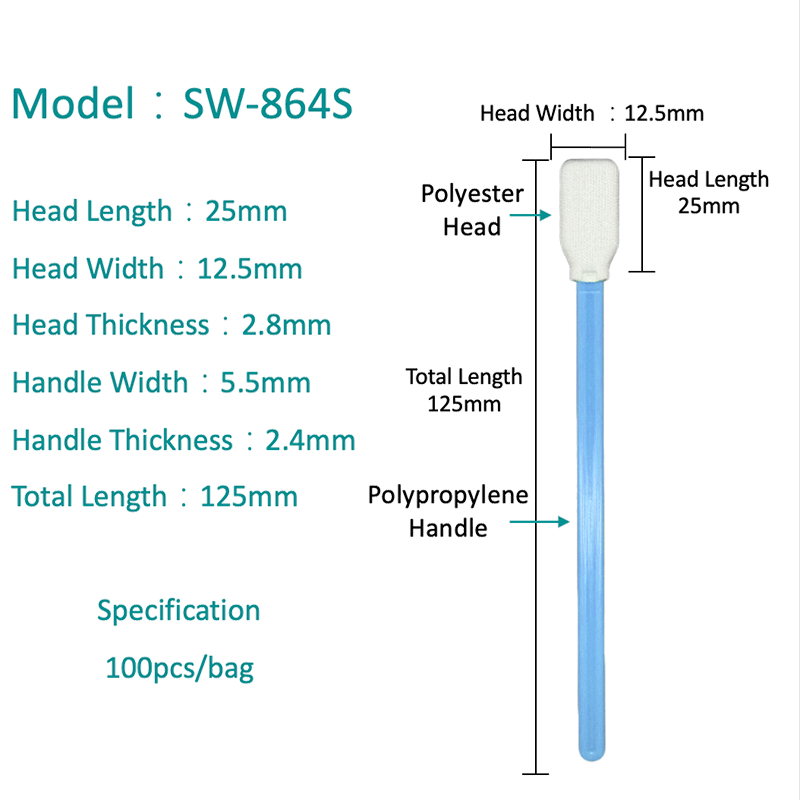
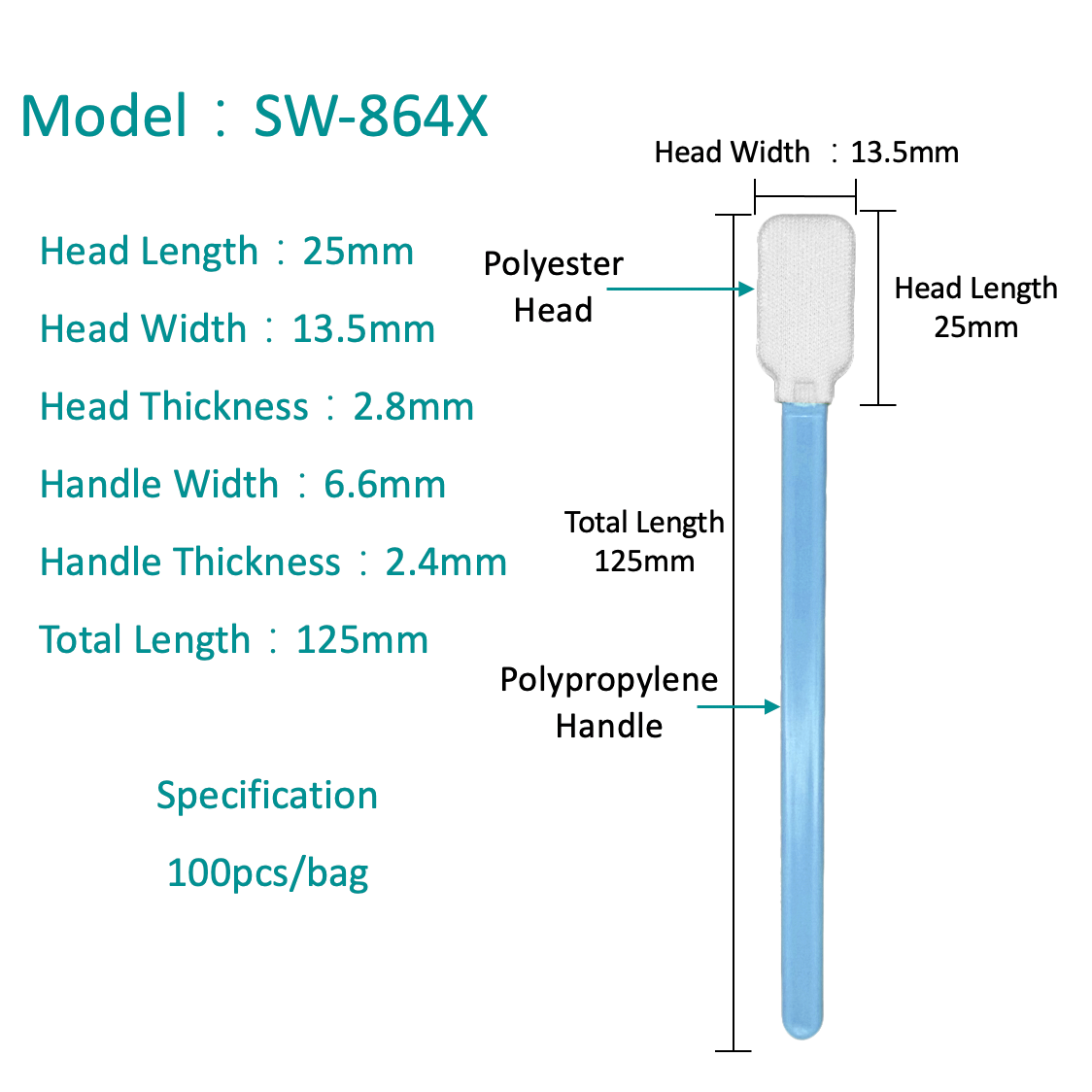
Polyester-tipped swabs are the most widely specified lint free option across electronics manufacturing, medical device assembly, and general cleanroom maintenance. The continuous-filament polyester knit fabric is thermally bonded to the tip form — no cut edges, no loose fiber ends. Polyester offers excellent chemical resistance to IPA, acetone, MEK, and most common cleaning solvents, low extractables, and consistent absorbency. Particle counts on certified cleanroom-grade polyester swabs typically fall below 1,000 particles ≥0.5 µm per swab.
Foam (Open-Cell Polyurethane)
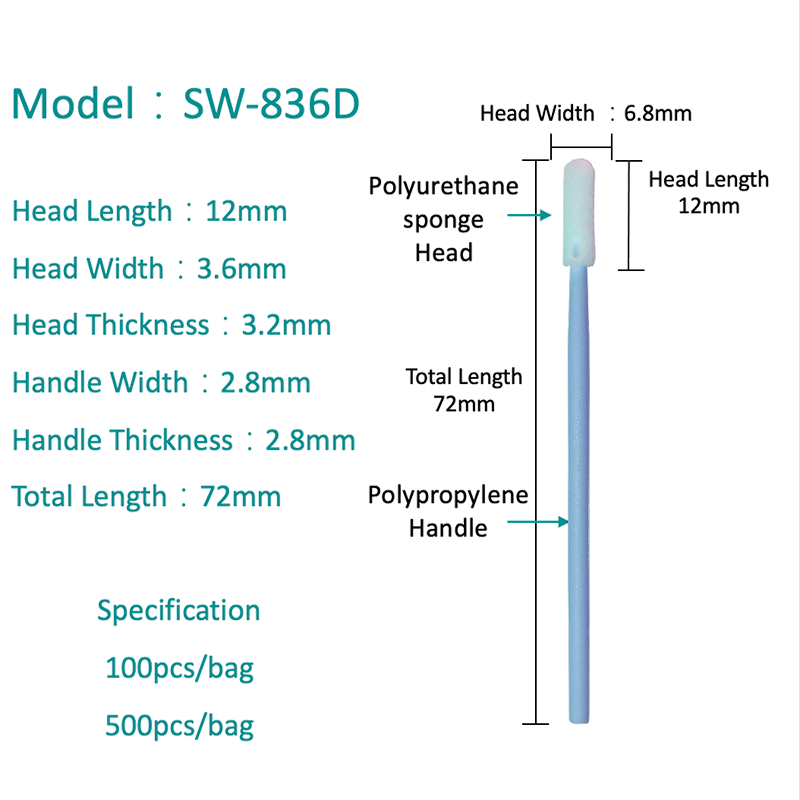
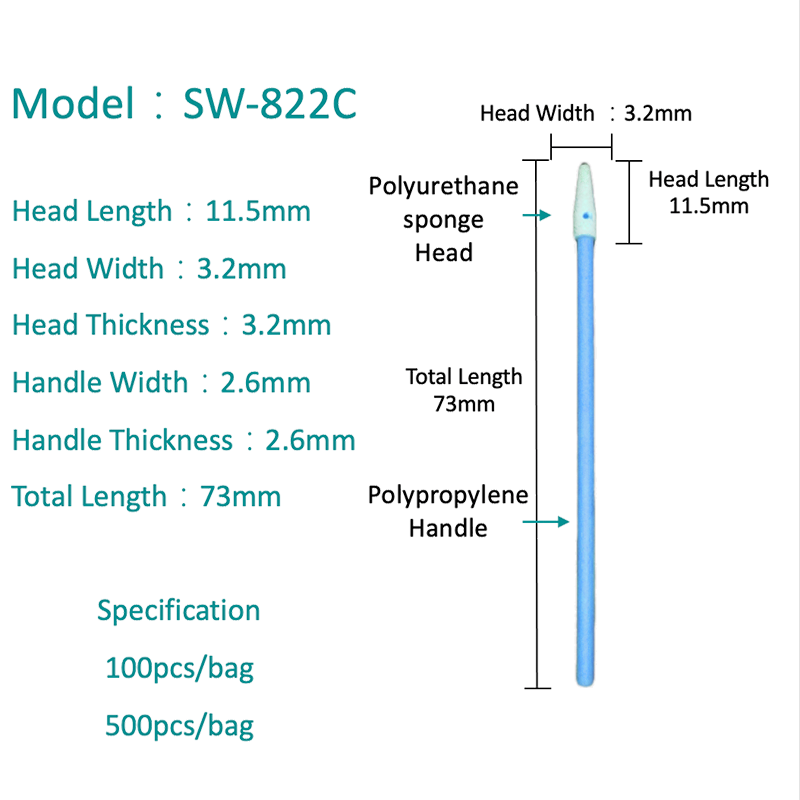
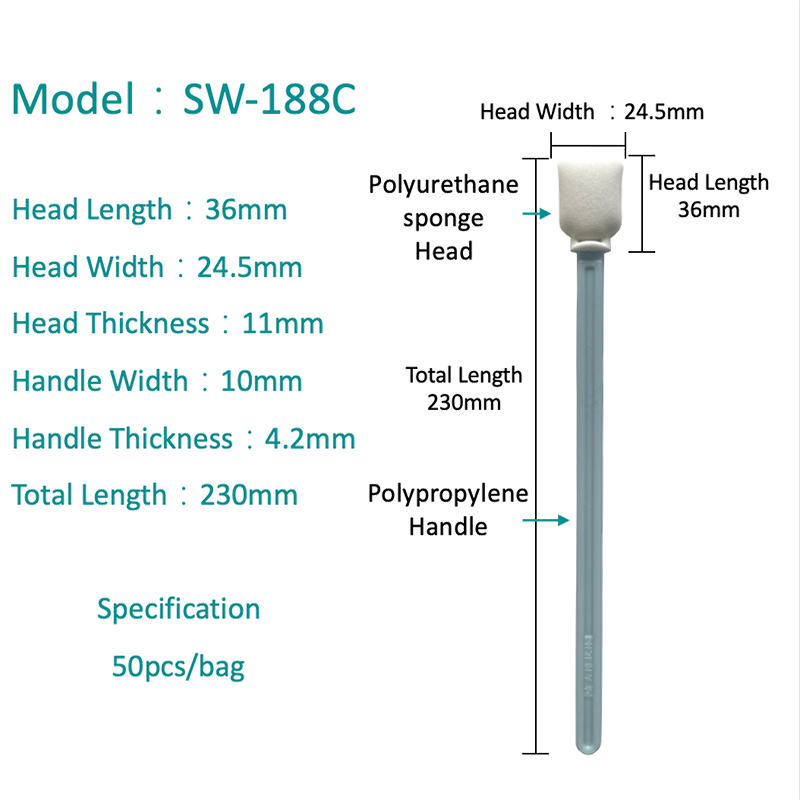
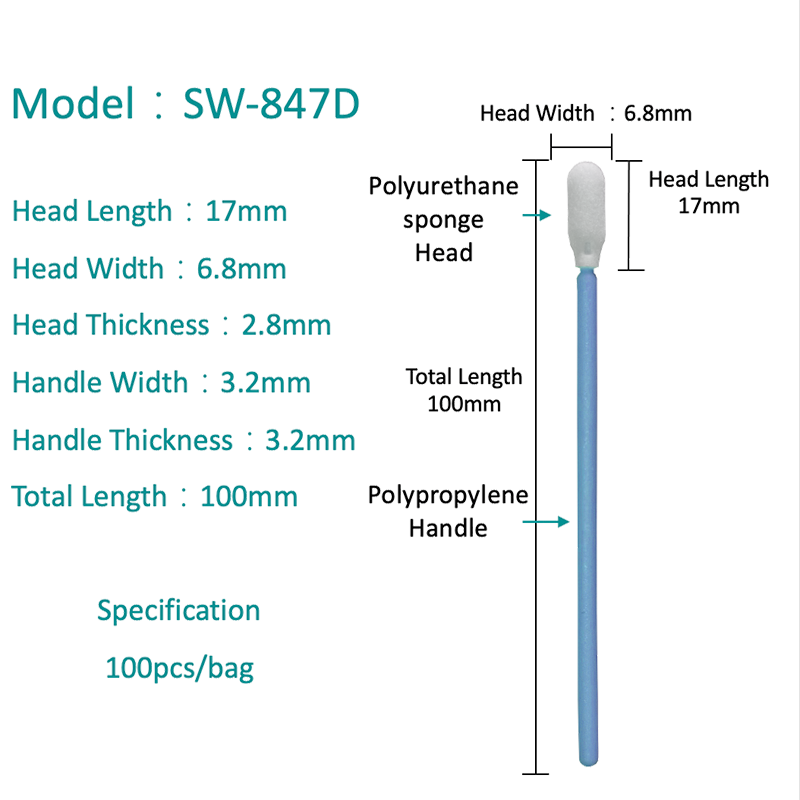
Foam-tipped swabs have a cellular, open-pore structure that delivers very high fluid uptake and release capacity — significantly more than a fabric-knit tip of equivalent size. The foam matrix does not shed cut fibers in the same way as textile tips, making it a low-lint option for applications requiring high solvent loading. However, polyurethane foam is not fully chemically inert — it can be attacked by ketones and certain chlorinated solvents, and may release small quantities of foam fragments under aggressive mechanical use. Foam swabs are well-suited to applying flux removers, lubricants, and cleaning solutions to PCB assemblies, hard drive components, and printer heads.
Microfiber (Split Microfiber / Ultrafine Polyester-Nylon Blend)
Microfiber swabs use fabrics constructed from fibers split to sub-denier diameters (typically 0.1–0.5 denier), creating a very high surface area tip that mechanically traps and retains particles rather than simply wiping them aside. This makes microfiber swabs particularly effective for optical surface cleaning — camera sensors, lenses, endoscope optics, and laser mirrors — where the goal is particle removal rather than solvent delivery. The fine fiber structure also reduces streak risk on polished surfaces.
Rayon (Viscose)
Rayon-tipped swabs occupy a middle ground — lower lint than cotton, higher absorbency than polyester, and better compatibility with aqueous transport media than synthetic fibers. They are the standard tip material for clinical and diagnostic sampling swabs (throat, nasal, wound culture), where the priority is maximizing specimen collection and elution into transport media rather than particle cleanliness. Rayon swabs are not appropriate for solvent-based electronics cleaning, as rayon degrades in many organic solvents.
Nylon Flocked
Flocked nylon swabs have a tip surface covered with short nylon fibers electrostatically applied perpendicular to the shaft, creating a velvet-like structure with a very high number of fiber tips at the surface. This geometry maximizes cell collection efficiency in biological sampling — particularly for nasopharyngeal and buccal swabs used in PCR-based diagnostics and forensic DNA collection — because the upright fibers efficiently dislodge and retain cells rather than trapping them deep in a matrix from which elution is incomplete. Flocked swabs have become the preferred format for COVID-19 and influenza rapid antigen and PCR testing.
| Tip Material | Lint / Particle Level | Solvent Resistance | Primary Use |
|---|---|---|---|
| Cotton | High | Poor (degrades) | Personal care, crafts |
| Rayon | Low–Medium | Poor (aqueous only) | Clinical specimen collection |
| Polyester Knit | Very Low | Excellent | Electronics, cleanroom, pharma |
| Foam (PU) | Low | Good (avoid ketones) | PCB cleaning, fluid application |
| Microfiber | Very Low | Good | Optical surfaces, sensors, lenses |
| Nylon Flocked | Very Low | Moderate | Diagnostic sampling, forensics, PCR |
Handle Materials and Geometry: Why They Matter
The handle is not a passive component. In critical applications, the handle material contributes to the swab's total extractables profile and must be compatible with the cleaning solvent or transport medium used. Common handle materials and their implications are:
- Polypropylene (PP) — the standard handle material for cleanroom and industrial swabs; chemically inert to most solvents, rigid, and low-extractable. Does not absorb moisture. The appropriate choice for IPA, acetone, and aqueous cleaning applications.
- Polystyrene (PS) — lower cost than PP but attacked by ketones and many organic solvents; suitable for aqueous and IPA applications only. Common in diagnostic and medical swab handles.
- Wood — traditional handle material for clinical sampling swabs; not appropriate for solvent-based cleaning due to particle shedding and extractable organic compounds. Being phased out in favour of plastic in most diagnostic applications.
- Aluminum or stainless steel — used in specialized precision cleaning swabs for aerospace and optics applications where dimensional rigidity and extremely low extractables are required; significantly higher cost than polymer handles.
Tip geometry is equally application-specific. Round or cylindrical tips suit general-purpose cleaning and specimen collection. Tapered tips access recessed connectors, small orifices, and hard-to-reach joints. Paddle or flat tips provide maximum surface contact for cleaning flat surfaces such as read/write heads, optical flats, and sealing faces. Elongated handles improve access in confined spaces on assembled equipment or in laboratory tubes.
Industry Applications of Lint Free Swabs
Lint free swabs serve as precision tools across a range of industries where surface cleanliness, contamination control, or specimen integrity are non-negotiable:
- Electronics manufacturing — flux residue removal from PCB solder joints, connector contact cleaning, conformal coating rework, and contamination inspection swabbing. Polyester knit swabs pre-wetted with IPA are the standard tool for post-solder cleaning of through-hole and SMT assemblies.
- Pharmaceutical and biotech cleanrooms — surface sampling for environmental monitoring programs, cleaning verification swabs (residue swabbing per ASTM E1792), and sterile component handling. Swabs used for residue sampling must be validated for analyte recovery efficiency specific to the active ingredient being detected.
- Medical device assembly — application of bonding agents, lubrication of sealing surfaces, cleaning of mating faces prior to assembly, and final cleanliness inspection of implantable or critical components.
- Optics and photonics — sensor cleaning for digital cameras, DSLR, and mirrorless bodies; cleaning of laser optics, telescope mirrors, and precision optical instruments. Microfiber swabs matched to the sensor width, used with dedicated optical cleaning solvents, are the industry standard technique.
- Aerospace and defence — cleaning of fuel system components, hydraulic fittings, and avionics connectors where particle contamination causes system failures; swab cleanliness specifications in aerospace procurement often reference MIL-STD-1246 cleanliness levels.
- Diagnostics and life sciences — specimen collection for PCR, rapid antigen tests, microbiology cultures, and forensic DNA analysis. In these applications, the swab's biological compatibility — absence of PCR inhibitors and nuclease contamination — matters as much as its physical construction.
For procurement teams sourcing lint free swabs, the most effective approach is to request product data sheets confirming particle count test methodology and results, extractables data for the relevant cleaning solvent, and — for pharmaceutical and medical applications — a Certificate of Conformance and lot traceability documentation. Swab qualification should always include a practical trial on the actual surface and with the actual cleaning agent used in production, as performance on a reference substrate does not always translate directly to performance on a specific component geometry or surface finish.

 ADDRESS
 CONTACT
 FAX
FAX EMAIL
EMAIL
