



 English
  中文简体
中文简体 
HOME / NEWS / Industry News / Technical Analysis of Dust-Free Foam Head Cleanroom Swabs in Precision Manufacturing
In the high-stakes environment of semiconductor fabrication and medical device assembly, micro-contamination is the silent enemy of yield. The Dust-Free Foam Head Cleanroom Swab has emerged as a fundamental tool for critical surface cleaning. Unlike standard cotton applicators, these specialized instruments are engineered to provide superior solvent capacity while maintaining near-zero particulate shedding. Understanding the metallurgical and chemical interactions at the tip of a Dust-Free Foam Head Cleanroom Swab is essential for engineers tasked with maintaining ISO Class 4 to 7 environments. This article examines the material science behind foam swabs, focusing on solvent compatibility and non-volatile residue (NVR) management.
1. Material Science: Open-Cell vs. Closed-Cell Foam Structures
The efficacy of a Dust-Free Foam Head Cleanroom Swab is primarily dictated by its polyurethane structure. Open-cell foam is characterized by an interconnected network of pores, which provides an expansive surface area for entrapping contaminants. Conversely, closed-cell foam is more rigid and less absorbent but offers higher abrasion resistance. For precision optics, the soft, non-abrasive nature of lint-free foam swabs for electronics ensures that delicate coatings are not scratched during the removal of flux residues or fingerprints. Engineers must choose the cell structure based on whether the primary goal is liquid absorption or mechanical scrubbing.
| Foam Property | Open-Cell Polyurethane | Closed-Cell Polyurethane |
| Solvent Retention | Superior (High capillary action) | Low (Surface tension-based) |
| Particulate Entrapment | High (Internal pore storage) | Moderate (Surface only) |
| Durability/Scrubbing | Moderate (Prone to snagging) | High (Tear resistant) |
2. Chemical Integrity: Cleanroom Swab Material Compatibility
When performing precision cleaning, the interaction between the swab head and cleaning solvents like Isopropyl Alcohol (IPA) or Acetone is critical. Cleanroom swab material compatibility refers to the swab's ability to resist chemical breakdown. Inferior foam swabs may leach plasticizers or adhesives into the environment, resulting in high levels of Non-Volatile Residue (NVR). High-quality Dust-Free Foam Head Cleanroom Swab variants use thermally bonded heads instead of adhesives, effectively eliminating the risk of chemical contamination. This is vital when using IPA-compatible foam swabs for cleanrooms, as the solvent must remain pure to ensure a residue-free finish on silicon wafers or magnetic heads.
| Solvent Type | Polyurethane Foam Reaction | Polyester Swab Comparison |
| Isopropyl Alcohol (IPA) | Excellent stability; minimal swelling | Excellent; very low NVR |
| Acetone | Poor; foam may degrade/expand | Excellent; highly resistant |
| Deionized Water | Excellent; no reaction | Excellent; no reaction |
3. Quantitative Metrics: NVR and Particulate Counts
For engineers, the choice of a cleanroom swab is backed by data. Non-volatile residue is measured in micrograms per swab, representing the contaminants left behind after a solvent evaporates. A professional-grade Dust-Free Foam Head Cleanroom Swab typically exhibits NVR levels below 0.15 mg/swab. Additionally, ESD-safe foam swabs for sensitive components incorporate dissipative handles to prevent static discharge, which could attract airborne dust or damage integrated circuits. The particulate count is usually measured for particles 0.5 microns and larger, ensuring the tool does not introduce the very contaminants it is designed to remove.
Comparison: Foam vs. Polyester Swab Technical Specs
While foam swabs offer the best liquid capacity, polyester swabs are generally preferred for ultra-low NVR requirements in extremely critical zones.
| Technical Metric | Foam Head Swab | Polyester Head Swab |
| Absorbency | High (15-20 microliters) | Low (5-10 microliters) |
| Particulate Generation | Low | Ultralow |
| NVR (DI Water) | < 0.20 mg | < 0.05 mg |
4. Precision Applications: From Optics to Aerospace
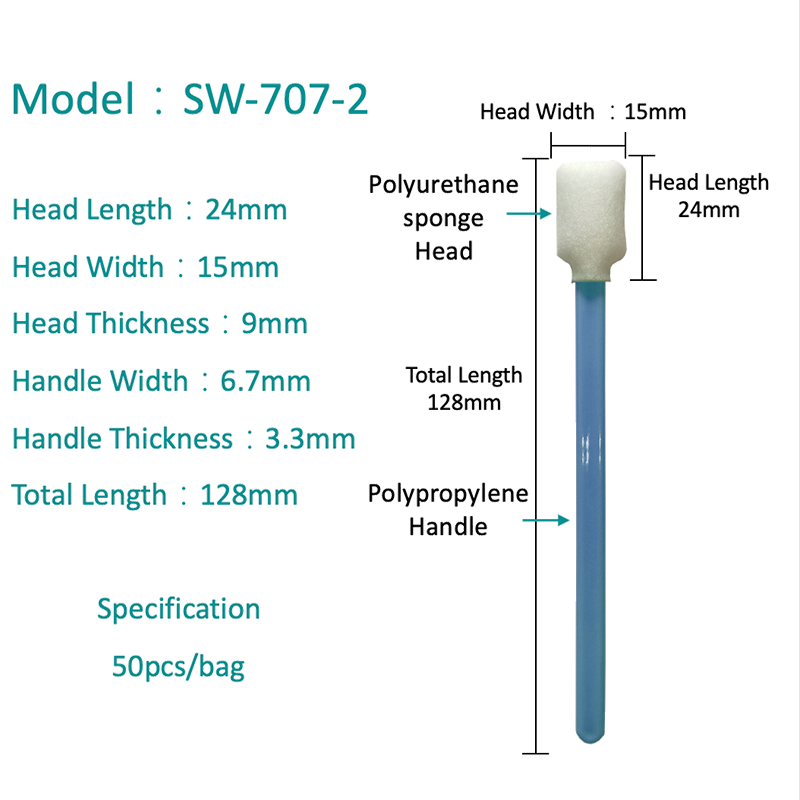
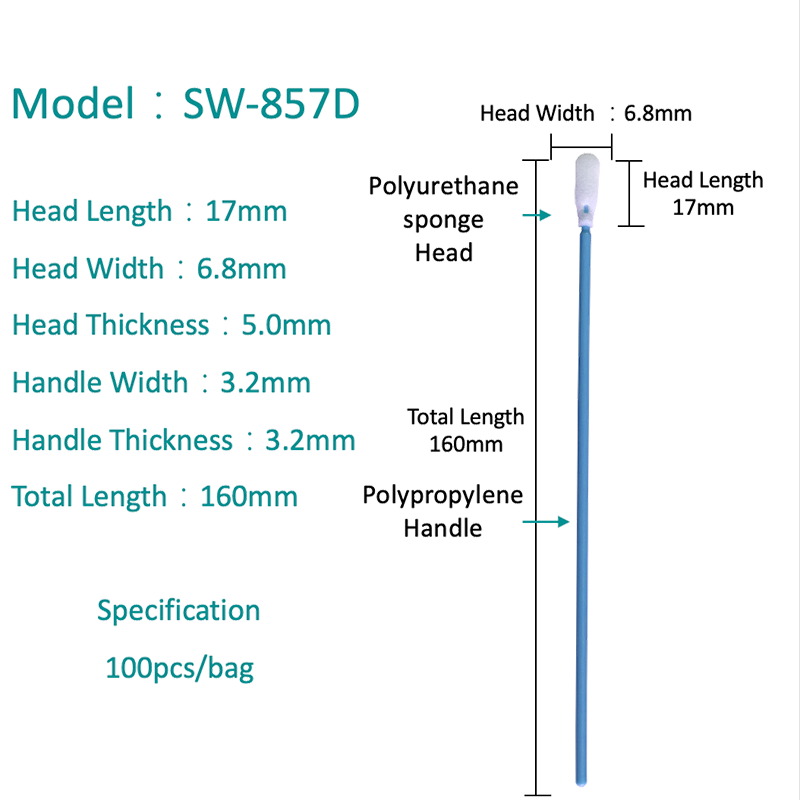
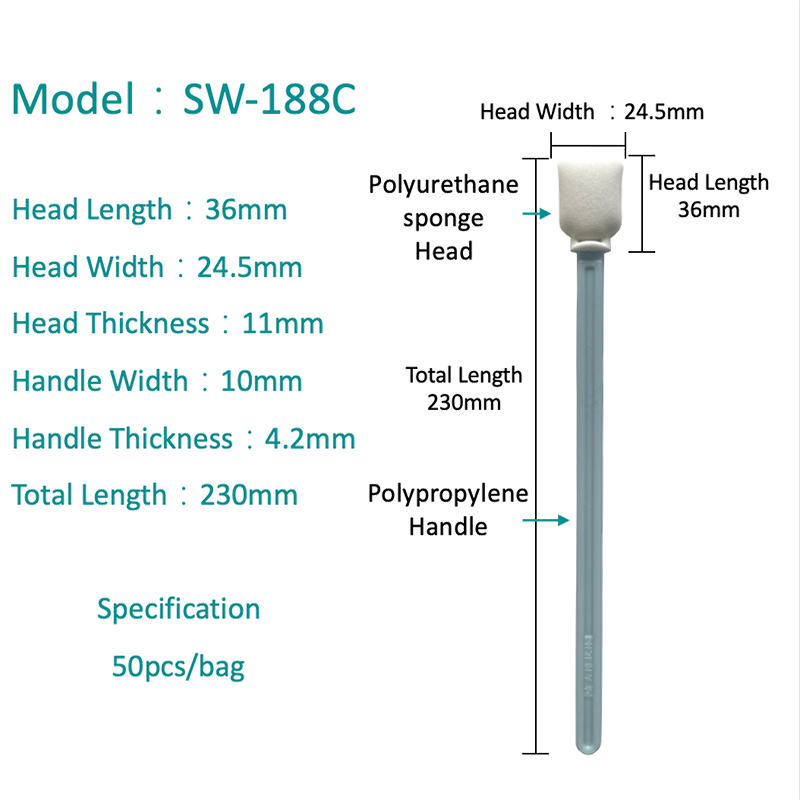
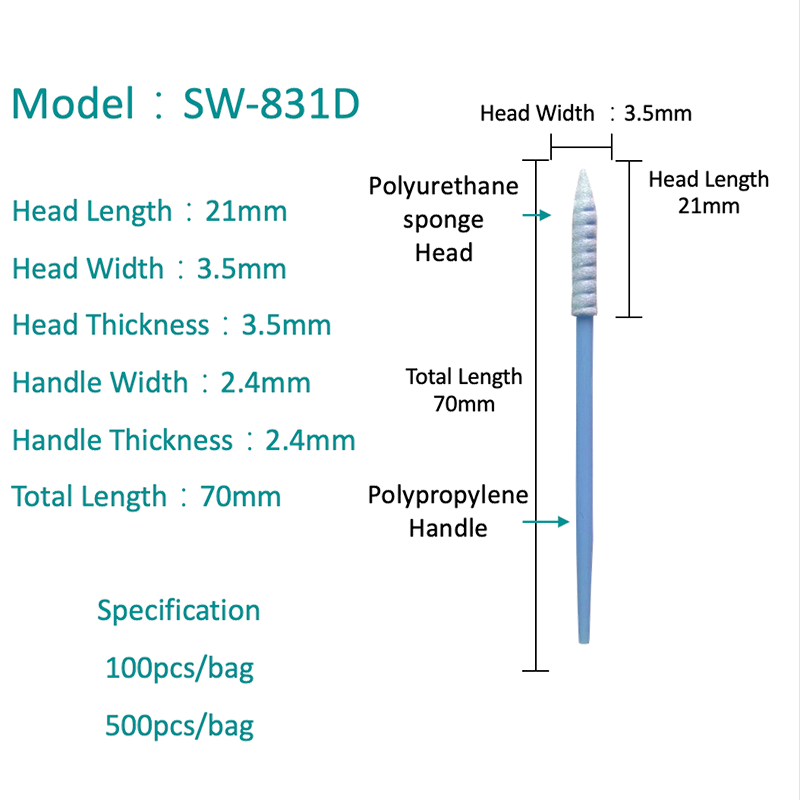
The versatility of the Dust-Free Foam Head Cleanroom Swab allows for its use across diverse sectors. In aerospace, low particulate foam swabs for laboratory use are utilized for cleaning fuel injection ports, where even a single fiber could cause a mechanical failure. In medical device manufacturing, the focus shifts to sterile cleanroom foam swabs for medical devices, which must be free of bioburden and pyrogens. These swabs are often double-bagged and gamma-irradiated to maintain the highest levels of purity. When choosing the right swab for precision cleaning, engineers must evaluate the handle length, head shape (tapered vs. square), and the specific cleanliness class of the production line.
- Semiconductors: Cleaning residue from wafer edges.
- Optics: Removing oils from high-definition lenses.
- Biotech: Surface sampling for TOC (Total Organic Carbon) analysis.
- Electronics: Removing solder paste from PCB surface mount components.
5. Conclusion: Ensuring Yield through Contamination Control
A Dust-Free Foam Head Cleanroom Swab is more than a simple cleaning tool; it is a precision-engineered instrument designed to protect high-value assets. By selecting swabs with high cleanroom swab material compatibility and low particulate shedding, manufacturers can significantly reduce defect rates. Whether utilizing lint-free foam swabs for electronics or ESD-safe foam swabs for sensitive components, the goal remains the same: achieving a molecularly clean surface without compromising the integrity of the work environment.
Frequently Asked Questions (FAQ)
1. Why is thermal bonding preferred over adhesives in a Dust-Free Foam Head Cleanroom Swab?
Thermal bonding uses heat to fuse the foam head to the handle. Adhesives can dissolve when in contact with solvents like IPA, leading to chemical contamination known as Non-Volatile Residue (NVR).
2. Can I use IPA-compatible foam swabs for cleanrooms with stronger solvents?
It depends on the foam type. Standard polyurethane foam is excellent for IPA but may swell or disintegrate if used with aggressive solvents like Acetone or MEK. Always check the chemical compatibility chart first.
3. What makes a swab "ESD-safe"?
ESD-safe foam swabs for sensitive components feature handles made from inherently dissipative polymers or carbon-filled plastics. This prevents the buildup of static electricity that could damage microchips.
4. How do I know if I need sterile cleanroom foam swabs for medical devices?
If your manufacturing process involves implants or instruments that will have direct contact with human tissue or blood, sterile swabs are required to ensure no bacteria or pyrogens are introduced.
5. What are the best low particulate foam swabs for laboratory use?
The best swabs are those washed in high-purity DI water during the manufacturing process and packaged in a Class 10 (ISO 4) cleanroom. Look for swabs with certified low particulate counts on the technical datasheet.
Industry References
- ISO 14644-1: Cleanrooms and associated controlled environments.
- IEST-RP-CC004: Evaluating Wiping Materials Used in Cleanrooms and Other Controlled Environments.
- ASTM E595: Standard Test Method for Total Mass Loss and Collected Volatile Condensable Materials.

 ADDRESS
 CONTACT
 FAX
FAX EMAIL
EMAIL
